3 Letter Words List with Meanings – Complete Guide & Examples
Introduction
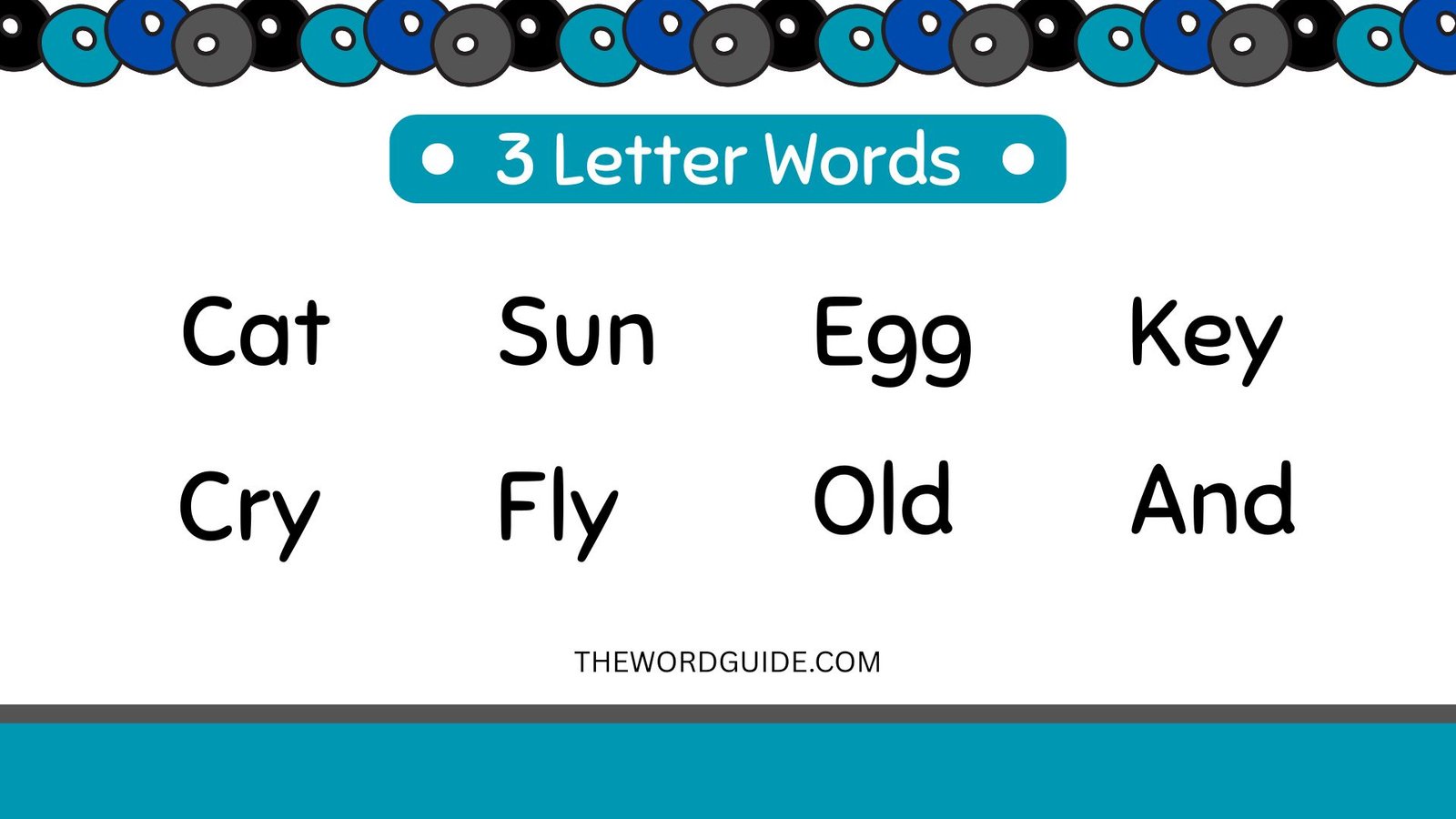
When people think about building a strong vocabulary, they usually imagine long, complicated words full of syllables and hidden meanings. But here’s a secret that most language learners overlook: the smallest words in English often carry the heaviest weight. Three-letter words are the backbone of everyday communication — they show up in children’s first reading lessons, in casual conversations, in professional emails, and even in Scrabble games where a well-placed short word can turn the tide of a match.
This article takes a fresh look at 3 letter words — what they are, why they matter, how they’re used, and a categorized table you can actually use for learning, teaching, or word games.
Why 3 Letter Words Deserve Attention
Short words are often dismissed as “too simple” to study, but that assumption is misleading for several reasons:
- They are foundational. Most children learn to read using 3-letter words like cat, dog, and run before moving on to longer vocabulary. These words build phonemic awareness and reading confidence.
- They are everywhere. In everyday spoken and written English, short words like the, and, for, and you appear far more frequently than long, complex words. Frequency matters — the more common a word is, the more useful it is to master.
- They are flexible. Many 3-letter words can function as multiple parts of speech. For instance, run works as a verb in “I run every morning” and as a noun in “I went for a run.” This flexibility makes them powerful tools for concise writing.
- They win games. In word games like Scrabble, Words With Friends, or crossword puzzles, knowing obscure but valid 3-letter words (like zax, qat, or xit) can be the difference between a mediocre score and a winning one.
- They sharpen writing. Professional writers often favor short words over long ones to make sentences punchy and readable. Replacing “utilize” with “use” or “commence” with “start” instantly improves clarity.
Categories of 3 Letter Words
To make this more useful, let’s break 3-letter words into practical categories rather than just listing them randomly.
1. Everyday Nouns
Words that name common objects, animals, or people.
2. Common Verbs
Action words used constantly in daily speech.
3. Adjectives and Descriptive Words
Words that describe qualities or states.
4. Function Words (Grammar Words)
Prepositions, conjunctions, articles, and pronouns that hold sentences together.
5. Unusual or Game-Worthy Words
Rare or specialized 3-letter words useful for word games, often unfamiliar to casual speakers.
3 Letter Words with Meanings
| Word | Category | Meaning |
|---|---|---|
| Cat | Noun | A small domesticated feline animal |
| Dog | Noun | A domesticated canine animal |
| Sun | Noun | The star at the center of our solar system |
| Sky | Noun | The space above the earth visible from the ground |
| Bed | Noun | A piece of furniture used for sleeping |
| Car | Noun | A road vehicle used for transport |
| Egg | Noun | An oval object laid by birds, reptiles, or fish |
| Fan | Noun | A device used to move air, or an enthusiastic supporter |
| Jar | Noun | A container, usually glass, with a wide mouth |
| Key | Noun | A tool used to lock or unlock something |
| Run | Verb | To move quickly on foot |
| Eat | Verb | To consume food |
| Sit | Verb | To rest on one’s buttocks |
| Cry | Verb | To shed tears, usually from emotion |
| Buy | Verb | To purchase something |
| Try | Verb | To attempt something |
| Dig | Verb | To break up or move earth with a tool |
| Fly | Verb | To move through the air |
| Win | Verb | To succeed in a contest or competition |
| Ask | Verb | To pose a question |
| Big | Adjective | Large in size |
| Sad | Adjective | Feeling or showing sorrow |
| Hot | Adjective | Having a high temperature |
| Wet | Adjective | Covered or soaked with liquid |
| Old | Adjective | Aged, having been around for many years. |
| New | Adjective | Recently made or created |
| Shy | Adjective | Nervous or timid in social situations |
| Odd | Adjective | Strange or unusual |
| Raw | Adjective | Uncooked or unprocessed |
| Fit | Adjective | Physically healthy or suitable |
| The | Article | Used to refer to a specific noun |
| And | Conjunction | Used to connect words or clauses |
| For | Preposition | Indicating purpose or recipient |
| But | Conjunction | Used to show contrast |
| Not | Adverb | Used to negate a statement |
| Are | Verb (to be) | Present tense plural form of “be” |
| Has | Verb (to have) | Present tense singular form of “have” |
| Off | Adverb/Preposition | Away from a position or state |
| Out | Adverb/Preposition | Away from the inside of something |
| Yet | Adverb | Up until now |
| Zax | Noun (rare) | A tool used to cut roofing slate |
| Qat | Noun (rare) | A plant chewed as a stimulant in parts of Africa and Arabia |
| Xit | Noun (rare, Scrabble word) | Variant term occasionally accepted in word games |
| Awn | Noun (rare) | A bristle-like part of a grass or cereal plant |
| Elm | Noun | A type of deciduous tree |
| Owl | Noun | A nocturnal bird of prey |
| Fox | Noun | A small wild canine known for cunning behavior |
| Web | Noun | A network of threads spun by a spider |
| Ink | Noun | A colored liquid used for writing or printing |
| Cow | Noun | A domesticated farm animal raised for milk |
| Pig | Noun | A domesticated farm animal raised for meat |
| Bee | Noun | A flying insect known for making honey |
| Ant | Noun | A small insect that lives in organized colonies |
| Sea | Noun | A large body of salt water |
| Ice | Noun | Water frozen into a solid state |
| Fog | Noun | A thick cloud of water droplets near the ground |
| Map | Noun | A visual representation of an area |
| Cup | Noun | A small container used for drinking |
| Pen | Noun | A tool used for writing with ink |
| Hat | Noun | A covering worn on the head |
| Bag | Noun | A container used for carrying items |
| Job | Noun | A regular paid position of employment |
| Law | Noun | A rule established by an authority |
| War | Noun | An armed conflict between groups or nations |
| Joy | Noun | A feeling of great happiness |
| Air | Noun | The invisible gas mixture surrounding the earth |
| Sew | Verb | To join fabric using needle and thread |
| Cut | Verb | To divide something using a sharp tool |
| Hug | Verb | To hold someone closely with affection |
| Lie | Verb | To lie down in a horizontal position or to make a statement that is not true |
| Own | Verb | To possess something |
| Pay | Verb | To give money in exchange for goods or services |
| Low | Adjective | Not high in position or amount |
| Dry | Adjective | Free from moisture |
| Fat | Adjective | Having excess body weight |
| Bad | Adjective | Not good in quality or behavior |
| Tan | Adjective | A light brown color, often from sun exposure |
| Icy | Adjective | Covered with or resembling ice |
| Far | Adjective/Adverb | At a great distance |
| Any | Determiner | Used to refer to one or some of a thing |
| All | Determiner | The whole quantity of something |
| Who | Pronoun | Used to ask about a person’s identity |
| Why | Adverb | Used to ask the reason for something |
| How | Adverb | Used to ask about manner or method |
Fun Facts About 3-Letter Words
- The word “the” is the most frequently used word in the English language, and it happens to be just three letters long.
- Many of the shortest English words are also among the oldest, tracing back to Old English roots (sun, sky, bed, dog).
- In competitive Scrabble, players often memorize entire lists of obscure 3-letter words because they can be played in tight spaces on the board where longer words won’t fit.
- Some 3-letter words change meaning entirely based on context — for example, “bat” can mean a flying mammal or sports equipment.
- English has hundreds of valid 3-letter words, but only a small fraction are used regularly in daily conversation.
How to Use 3-Letter Words Effectively
- For beginners learning English: Start with everyday nouns and verbs from the table above. These form the foundation of basic sentence construction.
- For writers: Replace unnecessarily long words with shorter alternatives to improve readability and pacing.
- For word game enthusiasts: Memorize the “unusual” category words — they are often the key to unlocking high-scoring plays in tight board positions.
- For teachers: Use 3-letter word categories (noun, verb, adjective) as a simple way to introduce grammar concepts to young learners.
Also Read~ 2 Letter Words
Conclusion
Three-letter words may look small, but their impact on the English language is anything but minor. They form the building blocks of early literacy, keep everyday conversation flowing, add punch to professional writing, and even become secret weapons in word games. Whether you’re a student, a writer, a teacher, or a game player, taking a closer look at these compact words reveals just how much power can be packed into so few letters.
Sometimes, the smallest pieces really do hold the biggest value.
Frequently Asked Questions (FAQs)
1. What are 3-letter words used for?
They form the foundation of basic vocabulary — used in early reading education, everyday conversation, professional writing, and competitive word games like Scrabble and crossword puzzles.
2. What is the most commonly used 3-letter word in English?
The word “the” is the most frequently used word in the entire English language, despite being just three letters long.
3. Are there 3-letter words with more than one meaning?
Yes, many 3-letter words are flexible and can function as different parts of speech or carry multiple meanings depending on context — for example, “bat” (animal or sports equipment) or “run” (verb or noun).
4. Why do word game players memorize obscure 3-letter words?
Short, unusual words like “zax,” “qat,” or “xit” are extremely useful in tight board spaces, allowing players to score points where longer words simply won’t fit.
5. Are 3-letter words important for beginners learning English?
Absolutely. They are typically the first words taught in reading and writing lessons because they are easy to pronounce, spell, and remember, making them ideal building blocks for language learners.

1 Response
[…] 3 Letter Words List with Meanings – Complete Guide & Examples […]