VTO Meaning: Full Form, Definition, Uses, and Examples
Have you ever come across the abbreviation VTO and wondered what it means? You’re not alone. VTO is a commonly used abbreviation that can have different meanings depending on the situation, industry, or conversation. From workplace policies to business management and digital communication, this three-letter term appears in several contexts.
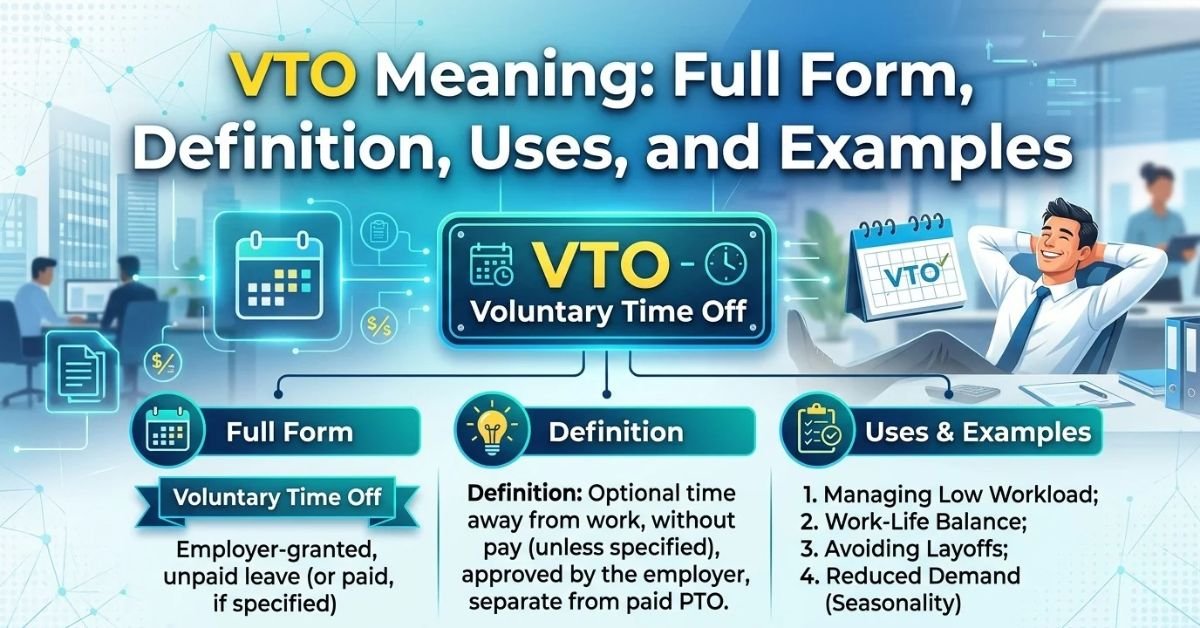
The most common meaning of VTO in the workplace is Voluntary Time Off. It refers to an arrangement that allows employees to take time away from work voluntarily, usually when business operations are slow or fewer workers are needed. However, VTO can also stand for other terms, such as Virtual Try-On and Vision, Traction, Organizer, depending on where it is used.
In this comprehensive guide, we’ll explore the VTO meaning, its full form, different applications, practical examples, benefits, and potential disadvantages. By the end, you’ll have a clear understanding of what VTO means and how to recognize its intended meaning in different situations.
What Does VTO Mean?
VTO is an abbreviation with several possible meanings. Its interpretation depends on the context in which someone uses it.
In employment and workplace environments, VTO most commonly stands for Voluntary Time Off. It is a company policy that gives employees the option to leave work early, take a day off, or reduce their working hours when their services are temporarily less necessary.
For example, imagine a company receives fewer customer orders than expected. Instead of having all employees work their regular shifts, management may offer VTO to workers who want additional time off.
In other industries, VTO can have completely different meanings:
- Voluntary Time Off: An optional break from scheduled work.
- Virtual Try-On: Technology that allows customers to see how products, such as glasses, makeup, or clothing, might look on them digitally.
- Vision, Traction, Organizer: A business-planning tool associated with the Entrepreneurial Operating System (EOS).
- Vehicle Take-Off: A term that may appear in specific automotive or technical contexts.
Therefore, understanding the surrounding conversation is essential before deciding what VTO means.
What Is the Full Form of VTO?
The full form of VTO depends on the industry or situation.
Here are some of its common expansions:
| Abbreviation | Full Form | Context |
|---|---|---|
| VTO | Voluntary Time Off | Employment |
| VTO | Virtual Try-On | Technology and shopping |
| VTO | Vision, Traction, Organizer | Business management |
| VTO | Vehicle Take-Off | Specialized technical contexts |
Among these definitions, Voluntary Time Off is particularly common in workplace conversations, while Virtual Try-On is widely associated with online shopping and digital retail experiences.
VTO Meaning in the Workplace
When employees or managers talk about VTO at work, they are usually referring to Voluntary Time Off.
It is a scheduling arrangement that allows employees to take time away from their regular duties when the company has fewer operational requirements.
Unlike mandatory leave, VTO is generally optional. Employees can decide whether they want to accept the offered time off, depending on the employer’s policy.
How Does Workplace VTO Work?
The process is usually straightforward:
- The company identifies low demand: Management determines that fewer employees are needed for a particular shift or working period.
- VTO opportunities are announced: Employees are informed that voluntary time off is available.
- Employees express interest: Workers who want additional time away from work can request VTO.
- Management approves requests: The company approves requests according to staffing requirements and internal policies.
- Employees take time off: Approved employees leave work or remain away from their scheduled shifts for the agreed period.
Some companies allow employees to request VTO through scheduling applications, employee portals, or direct communication with supervisors.
Is VTO Paid or Unpaid?
One of the most important questions employees ask is whether VTO is paid.
In many workplaces, Voluntary Time Off is unpaid. This means employees receive time away from work but do not earn their regular wages for the hours they miss.
However, payment arrangements depend on the employer’s specific policy.
Some organizations may offer paid VTO under special circumstances, while others provide only unpaid opportunities.
Before accepting VTO, employees should understand:
- Whether the time off is paid or unpaid.
- Whether accepting VTO affects their weekly income.
- Whether benefits or other employment arrangements are affected.
- Whether the decision can be reversed.
- Whether VTO affects attendance records or leave balances.
Always check your employer’s official policy instead of assuming that every VTO opportunity works the same way.
VTO Meaning in Different Industries
Although Voluntary Time Off is a common interpretation, VTO has several other meanings in professional and everyday environments.
Let’s explore some of the most relevant examples.
1. VTO Meaning in Technology: Virtual Try-On
In technology and online shopping, VTO commonly stands for Virtual Try-On.
Virtual Try-On is a digital technology that allows customers to preview products using their smartphones, computers, or other devices.
For example, someone shopping online for sunglasses may use their phone’s camera to see how different frames look on their face.
Similarly, beauty brands use Virtual Try-On tools to help customers experiment with lipstick shades, foundation, and other cosmetic products.
Examples of Virtual Try-On include:
- Trying on glasses using a smartphone camera.
- Testing different lipstick colors digitally.
- Previewing clothing styles using augmented reality.
- Seeing how accessories might look before purchasing them.
Virtual Try-On makes online shopping more interactive and can help customers make more informed purchasing decisions.
2. VTO Meaning in Business: Vision, Traction, Organizer
In business management, VTO can stand for Vision, Traction, Organizer.
It is a business-planning document used within the Entrepreneurial Operating System (EOS).
The VTO helps business owners and leadership teams organize their long-term vision and translate it into practical goals.
It generally covers important business areas, including:
- Company core values.
- Business purpose and direction.
- Long-term objectives.
- Marketing strategy.
- Three-year goals.
- Annual priorities.
- Quarterly objectives.
- Operational challenges.
The main purpose of the VTO is to help a business stay focused on its goals while maintaining accountability and consistent progress.
For example, a growing company might use a VTO to establish where it wants to be in three years and identify the most important priorities for the next 90 days.
3. VTO Meaning in Customer Service
In customer service and call centers, VTO often refers to Voluntary Time Off.
Customer support companies experience changing workloads throughout the day. During busy periods, they may need additional employees, while quieter periods may require fewer workers.
VTO helps managers adjust staffing levels without forcing employees to leave.
For example, if a call center receives fewer customer calls than expected, supervisors may offer employees the option to finish their shifts early.
This can help organizations manage staffing costs while giving employees additional personal time.
Practical Examples of VTO
Understanding VTO becomes easier when you see how people use it in everyday situations.
Here are several examples:
Example 1: VTO at a warehouse
A warehouse experiences a decrease in customer orders. Management announces that employees can voluntarily leave two hours before their scheduled finishing time.
Employees who accept the offer receive VTO.
Example 2: VTO in a call center
A customer support company expects fewer calls during the afternoon. Supervisors ask employees whether anyone wants to take voluntary time off.
Interested workers can request an early departure.
Example 3: VTO in online shopping
A customer visits an online eyewear store and uses a camera-based feature to see how different glasses look on their face.
This feature is called Virtual Try-On.
Example 4: VTO in business planning
A company owner creates a document outlining the organization’s long-term vision, annual targets, and quarterly priorities.
Within the EOS framework, this document is known as the Vision/Traction Organizer.
These examples demonstrate why context matters when interpreting the abbreviation.
Also Read! What Does EMR Mean? Definition, Uses, and Benefits
Benefits of VTO for Employees
When offered under a fair and transparent policy, Voluntary Time Off can provide several advantages for employees.
1. More Personal Time
Employees can use VTO opportunities to spend time with family, manage personal responsibilities, attend appointments, or simply relax.
2. Better Work-Life Balance
Having additional flexibility can help workers maintain a healthier balance between their professional responsibilities and personal lives.
3. Reduced Workplace Stress
Taking occasional time away from work may help employees recharge, particularly during demanding working periods.
4. Greater Flexibility
VTO provides employees with an opportunity to adjust their schedules when the company does not require its full workforce.
5. Opportunity for Rest
Employees working physically or mentally demanding jobs may appreciate opportunities to take additional breaks when available.
However, these benefits are most valuable when employees can afford the potential loss of wages associated with unpaid VTO.
Benefits of VTO for Employers
VTO is not only useful for employees. Organizations can also benefit from offering voluntary time off.
Some major advantages include:
1. Better workforce management: Companies can adjust staffing levels according to changing business demand.
2. Lower labor expenses: When VTO is unpaid, organizations may reduce labor costs during periods of lower activity.
3. Improved employee satisfaction: Giving employees greater scheduling flexibility can contribute to a more positive workplace experience.
4. Operational efficiency: Managers can better match staffing levels with actual business requirements.
5. Reduced unnecessary staffing: Companies can avoid scheduling more employees than they need during quieter periods.
When implemented properly, VTO can create a practical arrangement that benefits both workers and employers.
Disadvantages of VTO
Despite its advantages, VTO is not always the right choice for every employee or organization.
There are some potential disadvantages worth considering.
1. Reduced Income
The biggest disadvantage of unpaid VTO is the loss of wages.
Employees who depend on consistent weekly earnings may find it difficult to accept additional unpaid time off.
2. Limited Availability
VTO opportunities are not always available. Companies generally offer them when staffing requirements are lower.
3. Unpredictable Scheduling
Some employees may receive VTO opportunities at short notice, making it difficult to organize their personal schedules.
4. Possible Confusion About Policies
If employers do not clearly explain their VTO rules, employees may misunderstand payment arrangements, approval requirements, or attendance policies.
5. Unequal Opportunities
Depending on company procedures, some employees may receive more opportunities to accept VTO than others.
For these reasons, companies should establish transparent guidelines and communicate them clearly.
Difference Between VTO, PTO, and UTO
VTO is sometimes confused with PTO and UTO because all three abbreviations relate to time away from work.
However, they have different meanings.
| Term | Full Form | Meaning |
|---|---|---|
| VTO | Voluntary Time Off | Optional time away from scheduled work, often unpaid |
| PTO | Paid Time Off | Approved leave during which employees receive pay |
| UTO | Unpaid Time Off | Approved time away from work without regular wages |
VTO vs. PTO
The main difference is that PTO generally provides paid leave, while VTO is often unpaid.
For example, an employee may use PTO to take a paid vacation, whereas accepting unpaid VTO may reduce their earnings.
VTO vs. UTO
VTO is generally offered by an employer when fewer workers are needed, and employees choose whether to accept it.
UTO is a broader term for unpaid leave and may be requested by employees for personal reasons.
The exact distinction can vary between organizations.
How to Use VTO in a Sentence
VTO can be used in workplace conversations, business discussions, and technology-related contexts.
Here are some examples:
Workplace examples:
- “Our manager offered VTO because business was slow today.”
- “I accepted VTO and finished my shift early.”
- “Is VTO paid or unpaid at this company?”
- “Employees can request VTO through the scheduling system.”
Technology examples:
- “This website offers VTO for customers shopping for glasses.”
- “I used the Virtual Try-On feature to test different makeup shades.”
Business examples:
- “Our leadership team reviewed the VTO during the quarterly meeting.”
- “The company updated its Vision/Traction Organizer to reflect its new goals.”
These sentences show how the meaning changes depending on the topic.
Is VTO the Same as Voluntary Leave?
Not necessarily.
Although VTO and voluntary leave may sound similar, they are not always interchangeable.
Voluntary Time Off usually refers to an employer offering employees the opportunity to leave work when fewer workers are needed.
Voluntary leave can be a broader expression describing an employee’s decision to take leave voluntarily.
The differences depend on the company’s terminology and employment policies.
Also Read! TBH Meaning in Text: What Does TBH Stand For?
Frequently Asked Questions
1. What does VTO stand for?
VTO commonly stands for Voluntary Time Off in workplace environments. In other contexts, it can mean Virtual Try-On or Vision, Traction, Organizer.
2. Is VTO paid or unpaid?
VTO is often unpaid, but the payment arrangement depends on the employer’s policy. Employees should confirm the conditions before accepting it.
3. What does VTO mean at Amazon?
In Amazon warehouse and fulfillment center contexts, VTO generally refers to Voluntary Time Off. It allows eligible employees to accept an optional reduction in scheduled working hours when staffing needs permit. Specific availability and policies can vary by location and employment arrangement.
4. Is accepting VTO mandatory?
Generally, no. Voluntary Time Off is optional, meaning employees can decide whether to accept an available opportunity. However, they should follow their employer’s applicable scheduling procedures.
5. Does VTO affect your paycheck?
It can. If VTO is unpaid, accepting it generally reduces the wages an employee receives for the missed working hours.
6. Can employees request VTO?
Some companies allow employees to request VTO, while others offer it only when management identifies a staffing surplus. The process depends on workplace rules.
7. What does VTO mean in online shopping?
In online shopping, VTO usually means Virtual Try-On. It is a digital feature that lets customers preview products such as glasses, clothing, and makeup before buying them.
8. What does VTO mean in business management?
In the Entrepreneurial Operating System (EOS), VTO refers to the Vision/Traction Organizer. It is a planning tool that helps organizations define their vision and establish actionable business goals.
9. What is the difference between VTO and PTO?
VTO generally refers to Voluntary Time Off and is often unpaid. PTO stands for Paid Time Off and allows eligible employees to take approved leave while receiving their regular pay.
10. Why do companies offer VTO?
Companies offer VTO to manage staffing levels when business activity decreases. It can help reduce unnecessary labor costs while giving employees an opportunity to take additional time away from work.
Final Thoughts on VTO Meaning
The abbreviation VTO has multiple meanings, but Voluntary Time Off is one of its most common interpretations in workplace environments. It describes an arrangement that allows employees to voluntarily take time away from scheduled work, often when a company has fewer operational requirements.
VTO can also refer to Virtual Try-On in online shopping and Vision/Traction Organizer in business management. Each meaning serves a different purpose, making context essential for understanding the term correctly.
Whether you encounter VTO in an employee scheduling application, a business meeting, or an online shopping experience, knowing its different meanings can help you understand the conversation and respond appropriately.
Ultimately, the next time you see the abbreviation VTO, consider the situation before deciding what it means. A little context can make its meaning much easier to understand.