HRA Meaning: What Does HRA Stand For and How Does It Work?
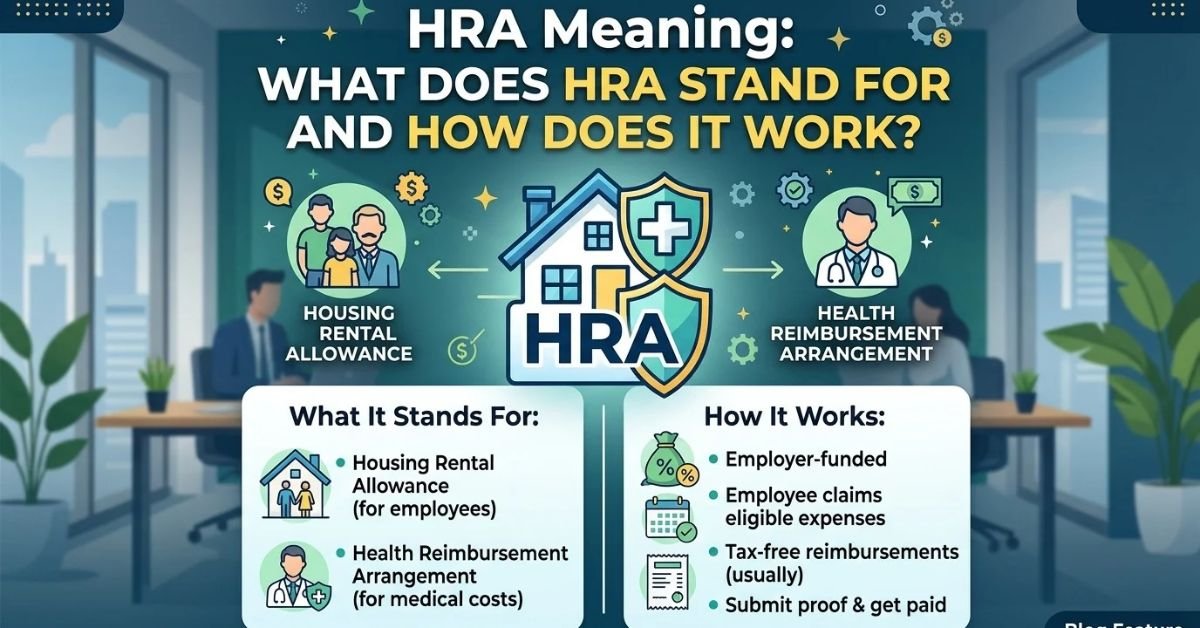
Understanding salary components, employee benefits, and workplace terminology can help people make better financial decisions. One term that frequently appears in salary discussions, employment contracts, and payroll documents is HRA. Although the abbreviation may look simple, its meaning and purpose can vary depending on the country, industry, and situation in which it is used.
In salary and employment contexts, HRA commonly stands for House Rent Allowance. It refers to an amount an employer provides to an employee to help cover the cost of rented accommodation. In some countries, particularly India, HRA is also an important part of discussions about salary structure and income tax exemptions.
However, HRA does not always refer to housing expenses. In the United States, for example, it can stand for Health Reimbursement Arrangement, an employer-funded benefit that helps employees pay for eligible healthcare expenses.
Understanding the context is therefore essential when interpreting this abbreviation.
In this comprehensive guide, we will explain the HRA meaning, its full form, how it works, its benefits, how it is calculated, and the important differences between its common uses. We will also answer frequently asked questions to help you understand the term without unnecessary confusion.
What Is the Meaning of HRA?
HRA is an abbreviation with different meanings depending on the subject being discussed. In employment and salary-related conversations, its most common meaning is House Rent Allowance.
House Rent Allowance is a salary component designed to help employees manage the cost of accommodation when they live in rented housing. Employers may include this allowance in an employee’s compensation package alongside basic salary and other benefits.
For example, an employee might receive a monthly salary consisting of basic pay, House Rent Allowance, a transport allowance, and other components. The HRA portion helps the employee meet rental expenses.
The exact amount depends on the employer’s salary structure, employment agreement, and applicable rules.
In another context, particularly in the American healthcare system, HRA means Health Reimbursement Arrangement. This is an employer-funded benefit that reimburses employees for eligible healthcare expenses under the terms of the plan.
Although both uses relate to employee benefits, they serve different purposes.
In simple terms:
- House Rent Allowance: Financial assistance from an employer toward rented accommodation.
- Health Reimbursement Arrangement: An employer-funded arrangement for reimbursing eligible healthcare expenses.
When someone searches for HRA meaning, the correct definition depends on whether they are discussing salary, housing, taxation, or healthcare.
What Does HRA Stand For?
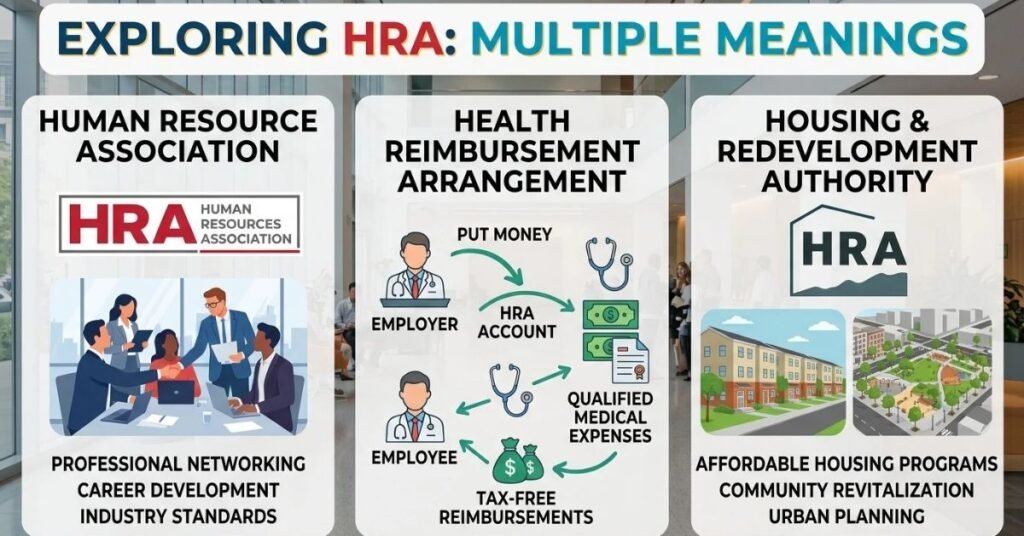
The full form of HRA depends on the context in which the abbreviation appears.
1. HRA Meaning in Salary
In salary and payroll terminology, HRA stands for House Rent Allowance.
Employers may provide this allowance to help employees pay rent for their residential accommodation. It is particularly relevant to salaried workers who live in rented houses, apartments, or other qualifying residential properties.
For example, a company might offer an employee a basic monthly salary of ₹30,000 and a House Rent Allowance of ₹12,000. The employee receives the allowance as part of the agreed salary package, subject to the employer’s payroll arrangements.
The amount received and its tax treatment depend on the applicable employment and tax rules.
2. HRA Meaning in Healthcare
In the United States, HRA commonly stands for Health Reimbursement Arrangement.
This is an employer-sponsored benefit that allows employees to receive reimbursement for qualifying medical expenses, subject to the arrangement’s terms and applicable regulations.
An employer may establish a specific reimbursement limit for a coverage period. Eligible expenses can include certain medical costs, deductibles, copayments, and, under qualifying arrangements, health insurance premiums.
Unlike a regular salary payment, HRA healthcare funds are restricted to expenses permitted under the plan.
3. HRA Meaning in Human Resources
In human resources discussions, HRA may refer to House Rent Allowance when the topic involves compensation, payroll, or employee benefits.
However, the abbreviation can also have other meanings in specialized organizational or administrative settings. Its definition should therefore be confirmed from the surrounding text.
If HRA appears on a salary slip, compensation statement, or employment contract, checking the document’s description can help identify its intended meaning.
What Is House Rent Allowance?
House Rent Allowance is a component of compensation that an employer may provide to an employee to help cover residential rental costs.
Rent is often one of the largest recurring expenses for working professionals. People who move to another city for employment, work away from their family homes, or live near their workplace may need to rent accommodation.
HRA helps employers structure compensation to account for this expense.
In India, House Rent Allowance is particularly significant because eligible salaried employees may qualify for an income tax exemption on part of the allowance under the applicable tax rules.
It is important to understand that receiving HRA and qualifying for an HRA tax exemption are not the same thing. An employee may receive the allowance as part of their salary, but the amount eligible for tax relief depends on the relevant conditions and tax regime.
The allowance also does not necessarily cover the employee’s entire rent. Employers determine the amount according to their compensation policies and employment agreements.
Why Do Employers Provide HRA?
Employers may include HRA in salary packages for several reasons.
Supporting housing expenses: Renting accommodation can place pressure on an employee’s monthly budget. HRA helps provide financial support.
Structuring compensation: Employers can divide a salary package into different components, including basic pay, housing allowances, and other benefits.
Attracting employees: Housing-related benefits may make a compensation package more appealing, especially when recruiting workers who must relocate.
Supporting payroll administration: A clearly defined allowance helps employers and employees understand how compensation is organized.
The actual advantages depend on the employer’s policy, the employee’s circumstances, and the rules governing the allowance.
How Does HRA Work?
The working of House Rent Allowance is relatively straightforward. An employer includes the allowance in an employee’s compensation package, and the employee receives it according to the payroll schedule.
However, the way HRA affects taxes depends on the country and the applicable regulations.
Let’s examine the process step by step.
Step 1: The Employer Determines the Salary Structure
When an employer offers a job, the compensation package may include several components.
These can include:
- Basic salary
- House Rent Allowance
- Transport or other allowances
- Performance-related payments
- Employer-provided benefits
Not every employer uses the same structure. Some companies provide HRA as a separate salary component, while others may use different arrangements.
The employee should review the employment offer or salary statement to understand how the allowance is calculated and paid.
Step 2: The Employee Receives the Allowance
If HRA is included in the employee’s salary, the amount is generally paid through the employer’s regular payroll process.
For instance, imagine an employee receives a monthly salary with the following components:
| Salary component | Monthly amount |
|---|---|
| Basic salary | ₹30,000 |
| House Rent Allowance | ₹12,000 |
| Other salary components | ₹8,000 |
| Total monthly salary | ₹50,000 |
In this illustrative example, the employee receives ₹12,000 per month as HRA.
The employee’s actual take-home pay may differ because of taxes, retirement contributions, insurance deductions, and other payroll adjustments.
Step 3: The Employee Pays Rent
The employee uses their available income to pay rent to the landlord.
For employees seeking an HRA tax exemption under India’s applicable rules, actual rental expenditure is an important consideration.
Simply receiving HRA does not automatically establish eligibility for an exemption. The employee must satisfy the relevant conditions, including the requirement to pay rent for qualifying accommodation.
Step 4: The Employee Provides Supporting Documents
Depending on the employer’s procedures and the applicable tax requirements, employees may be asked to submit rental information or supporting documents.
These may include:
- Rent receipts
- A rental agreement
- Details of the rented property
- The landlord’s information, where required
- Evidence of rental payments, if requested
The exact documentation requirements depend on the circumstances and applicable rules.
Employees should provide accurate information and retain their records in case verification is required.
Step 5: The Applicable Tax Rules Are Applied
The final step is determining whether any portion of the HRA qualifies for tax exemption.
In India, the calculation under the applicable House Rent Allowance exemption rules generally considers the actual allowance received, qualifying rent paid, salary, and the location of the rented accommodation.
The tax regime selected by the employee can also affect whether the exemption is available.
Consequently, the amount of HRA received should not automatically be treated as the amount exempt from income tax.
How Is HRA Calculated?
HRA calculation depends on the employer’s salary structure and, where relevant, the applicable tax regulations.
It is helpful to distinguish between two separate questions:
- How much HRA does the employee receive?
- How much of that HRA qualifies for tax exemption?
The employer determines the allowance under the salary arrangement. The tax exemption, where available, is calculated separately.
Understanding the HRA Tax Exemption Formula in India
Under India’s traditional HRA exemption framework, the exempt amount is generally the lowest of the following three figures:
- The actual HRA received from the employer.
- The qualifying rent paid minus 10% of the relevant salary.
- A specified percentage of the relevant salary: generally 50% for qualifying rented accommodation in Mumbai, Delhi, Kolkata, or Chennai, and 40% for other locations.
The relevant salary generally includes basic salary, qualifying dearness allowance, and qualifying commission where applicable under the rules.
Important: These calculations apply only where the employee is eligible to claim the exemption under the applicable tax provisions and tax regime. Tax rules can change, so employees should verify the rules for the relevant financial year.
HRA Calculation Example
Consider the following hypothetical situation:
- Monthly basic salary: ₹30,000
- Monthly HRA received: ₹12,000
- Monthly rent paid: ₹10,000
- Rented accommodation: A city other than Mumbai, Delhi, Kolkata, or Chennai
For simplicity, assume the relevant salary for this calculation is ₹30,000 per month and no additional qualifying salary components apply.
Calculation 1: Actual HRA received
The employee receives ₹12,000 per month.
Therefore, the first figure is ₹12,000.
Calculation 2: Rent paid minus 10% of salary
Monthly rent = ₹10,000
Ten percent of monthly salary = ₹3,000
Qualifying difference = ₹10,000 − ₹3,000 = ₹7,000
Therefore, the second figure is ₹7,000.
Calculation 3: Forty percent of salary
Forty percent of ₹30,000 = ₹12,000.
Therefore, the third figure is ₹12,000.
Final result
The lowest of the three amounts is ₹7,000.
Under these illustrative assumptions, ₹7,000 per month would qualify for exemption under this calculation.
The remaining ₹5,000 of the monthly HRA would not be exempt under the formula.
This example is intended to explain the calculation, not to determine anyone’s actual tax liability. Eligibility, salary components, the financial year, and the applicable tax regime must be checked before using the result for tax planning.
Is HRA Taxable?
The tax treatment of HRA depends on the country where the employee works and the applicable tax rules.
In India, HRA forms part of salary. Eligible employees may claim an exemption on a qualifying portion under the applicable provisions.
However, the entire allowance is not automatically tax-free.
The following factors may affect the exemption:
- Whether the employee actually pays rent
- The amount of HRA received
- The employee’s relevant salary
- The location of the rented property
- The period during which the accommodation is occupied
- The tax regime applicable to the employee
- Compliance with relevant documentation requirements
If an employee does not pay rent or lives in a property they own, the ordinary HRA exemption generally is not available for that period under the Indian framework.
Employees should also distinguish between an allowance being included in their salary and a portion being exempt from taxation.
For current Indian guidance, consult the official Income Tax Department’s information on salary income and HRA.
Tax treatment can differ substantially in other countries, so the Indian rules should not be applied internationally.
What Is the Difference Between HRA and Basic Salary?
Basic salary and House Rent Allowance are two different components of an employee’s compensation package.
Basic salary is the core fixed component of salary before additional allowances and other benefits are considered. HRA is a separate allowance intended to help cover residential rental expenses.
The differences can be summarized as follows:
| Feature | Basic Salary | House Rent Allowance |
|---|---|---|
| Meaning | Core salary component | Allowance for rental accommodation |
| Purpose | Compensation for employment | Assistance with housing expenses |
| Salary structure | Usually a foundational component | An additional salary component where provided |
| Tax treatment in India | Generally taxable, subject to applicable provisions | May qualify for an exemption under eligible circumstances |
| Dependence on rent paid | Not ordinarily linked to rent | Relevant to the HRA exemption calculation |
| Amount | Determined by the salary arrangement | Determined by the employer’s compensation structure |
Basic salary can also affect calculations for other employment benefits, depending on the applicable rules.
HRA, meanwhile, may provide additional financial support to employees who rent their accommodation.
Neither component should be evaluated in isolation when comparing two job offers. The total compensation package, deductions, benefits, and take-home pay are all important.
What Is the Difference Between HRA and a Housing Allowance?
The terms HRA and housing allowance may sound similar, but their exact meanings can depend on the employer and country.
House Rent Allowance is a specific salary component commonly used in India. A housing allowance is a broader term that may refer to different forms of employer-provided financial assistance for accommodation.
For example, an employer might offer a housing allowance to an employee who relocates for work. Another employer might provide accommodation directly instead of paying a separate allowance.
The tax treatment of these arrangements may differ.
Before assuming that two housing benefits work in the same way, employees should check their employment agreements and the relevant tax rules.
What Are the Benefits of HRA?
House Rent Allowance can offer several advantages to employees, particularly those who need to rent accommodation near their workplace.
1. Helps Manage Rental Expenses
Rent is a recurring financial commitment. HRA provides an additional salary component that can help employees manage this expense.
The amount may cover part of the rent or, in some cases, a larger proportion, depending on the employer’s policy and the cost of accommodation.
2. May Provide Tax Benefits
In India, eligible employees may qualify for an HRA exemption under the applicable tax provisions.
This can reduce the portion of salary subject to income tax, depending on the employee’s circumstances and the tax regime.
The exemption should be calculated carefully rather than assuming the entire allowance is tax-free.
3. Supports Employees Who Relocate
People frequently move to other cities for better employment opportunities.
HRA can help employees manage accommodation expenses when living away from their family home or relocating to an area with higher housing costs.
4. Adds Transparency to Compensation
Separating HRA from other salary components makes the structure of compensation easier to understand.
Employees can see how much of their salary is allocated to the housing allowance and assess whether the overall package meets their needs.
5. Can Improve the Value of a Salary Package
A well-structured compensation package may help an employee manage recurring expenses more effectively.
However, the value of HRA depends on the amount offered, actual housing costs, applicable taxes, and the employee’s other financial obligations.
A higher allowance does not necessarily mean a better overall package if other salary components or benefits are less favorable.
What Are the Limitations of HRA?
Although HRA can be useful, it also has limitations that employees should understand.
1. The Allowance May Not Cover the Full Rent
Employers generally determine the allowance as part of their compensation policies.
If the employee’s rent is high, the HRA received may cover only a portion of the total cost.
The employee must budget for any remaining amount.
2. Tax Exemption Is Not Automatic
Receiving HRA does not automatically make the allowance tax-free.
Employees must meet the relevant conditions before claiming an exemption under applicable tax rules.
3. Documentation May Be Required
Employees may need to provide rental details and other supporting documents.
Inaccurate information or missing documentation can create problems during payroll verification or tax assessment.
4. Tax Rules Differ by Country
The HRA exemption framework used in India is not a universal tax rule.
Employees working in other countries must follow the local laws that apply to their compensation.
5. Employer Policies May Vary
Not all employers structure compensation in the same way.
Some offer HRA as a separate component, while others use different salary arrangements. Employees should check the terms of their employment rather than assuming that every employer provides the same benefit.
What Does HRA Mean in the United States?
In the United States, HRA commonly refers to a Health Reimbursement Arrangement.
Unlike House Rent Allowance, this benefit relates to healthcare rather than housing.
A Health Reimbursement Arrangement is an employer-funded benefit that reimburses employees for eligible medical expenses under the plan’s terms and applicable federal rules.
The employer establishes the arrangement and determines its permitted structure. Employees can then submit eligible expenses for reimbursement, subject to the plan’s conditions.
How Does a Health Reimbursement Arrangement Work?
The process generally involves the following steps.
First, the employer establishes the arrangement.
The employer creates a plan that defines the benefit, reimbursement limits, eligibility requirements, and covered expenses.
Second, the employer funds the benefit.
HRAs are funded by employers rather than through employees’ voluntary salary contributions.
Third, the employee incurs an eligible healthcare expense.
The employee may pay for a qualifying medical service or other permitted expense.
Fourth, the employee submits a reimbursement request.
Depending on the plan, the employee provides documentation showing that the expense qualifies.
Finally, the plan reimburses the eligible expense.
The reimbursement is subject to the plan’s limits and applicable requirements.
Certain types of HRAs can reimburse individual health insurance premiums, while others operate under different rules. Eligibility requirements also vary by arrangement.
The official HealthCare.gov explanation of Health Reimbursement Arrangements provides additional information about this benefit.
Benefits of a Health Reimbursement Arrangement
A healthcare HRA may help employees manage expenses that are not fully covered by their primary health insurance.
Potential benefits include:
- Assistance with eligible medical expenses
- Reimbursement for certain deductibles and copayments
- Coverage of permitted healthcare costs
- Potential tax advantages under applicable rules
- Greater flexibility in how employers structure healthcare benefits
However, employees should review their specific plan to understand the eligible expenses, reimbursement limits, and conditions that apply.
House Rent Allowance vs. Health Reimbursement Arrangement
Although both benefits use the abbreviation HRA, their purposes and operation are very different.
| Feature | House Rent Allowance | Health Reimbursement Arrangement |
|---|---|---|
| Common context | Salary and payroll, especially in India | Employee healthcare benefits, especially in the United States |
| Main purpose | Help with residential rent | Reimburse eligible healthcare expenses |
| Funding | Paid as a salary allowance under the employment arrangement | Funded by the employer |
| How it is used | Helps the employee meet housing costs | Used for eligible healthcare costs |
| Tax treatment | Depends on local law and eligibility for any exemption | Qualified reimbursements may receive favorable federal tax treatment |
| Documentation | Rental records may be needed for tax purposes | Medical expense documentation may be required |
| Common terminology | House Rent Allowance | Health Reimbursement Arrangement |
The key distinction is that one concerns housing expenses, while the other concerns healthcare costs.
When interpreting HRA in a document, look at the surrounding information to determine which meaning applies.
How Can You Check HRA on a Salary Slip?
A salary slip, also called a payslip, provides a breakdown of an employee’s earnings and deductions for a particular pay period.
If HRA is included in the salary structure, it may appear as a separate line under earnings or allowances.
To understand it correctly, follow these steps.
Step 1: Find the earnings section.
Look for headings such as Basic Salary, Allowances, Earnings, or Salary Components.
Step 2: Locate the HRA entry.
It may be listed as HRA, House Rent Allowance, or a similar description.
Step 3: Check the monthly amount.
Identify the amount paid during the relevant payroll period.
Step 4: Compare it with your employment agreement.
Check whether the figure matches the compensation structure provided by your employer.
Step 5: Review tax deductions separately.
The HRA amount on the payslip does not necessarily equal the amount exempt from tax.
If the figures are unclear, the payroll or human resources department can explain the calculation and the relevant tax treatment.
Is HRA Included in Gross Salary?
In many salary structures, House Rent Allowance is included in gross salary.
Gross salary generally represents earnings before certain deductions, although the precise definition may vary depending on the document or context.
For example, suppose an employee receives:
- Basic salary: ₹30,000
- HRA: ₹12,000
- Other allowances: ₹8,000
The gross monthly salary would be ₹50,000 if these are the employee’s complete earnings components and there are no other additions.
The employee’s take-home pay could be lower after applicable deductions.
The distinction is important because gross salary, taxable salary, and net salary are not always identical.
Gross salary refers to earnings before deductions, taxable salary reflects the amounts subject to tax after applicable adjustments, and net salary is the amount received after payroll deductions.
HRA may be part of gross salary even when a qualifying portion is exempt from income tax.
Can You Claim HRA if You Live in Your Own House?
Under India’s traditional HRA exemption framework, the ordinary exemption generally requires the employee to pay rent for residential accommodation that is not owned by them.
If an employee lives in a house they own and does not pay qualifying rent, they generally cannot claim the usual HRA exemption for that period.
However, receiving HRA as part of a salary package and qualifying for the tax exemption are separate matters.
An employee may still receive an allowance under their compensation structure, but its tax treatment will depend on the applicable rules.
Employees who live in their own homes should check their specific circumstances and current tax provisions before claiming an exemption.
Also Read! FFS Meaning in Text: What Does It Stand For in Chat?
Can You Claim HRA if You Live with Your Parents?
In India, living with parents does not automatically prevent an employee from claiming an HRA exemption.
However, the arrangement must satisfy the applicable conditions.
For example, an employee who genuinely pays rent to a parent for qualifying accommodation may be eligible to claim an exemption, provided the arrangement is genuine and all relevant requirements are met.
The employee should maintain accurate records of the rental arrangement and payments.
The tax authorities may examine whether the rental arrangement is genuine, and the parent’s receipt of rental income may have separate tax implications.
Employees should not claim an exemption merely because a rent agreement exists. The underlying arrangement and payments must be genuine and consistent with the applicable rules.
Is HRA the Same as Rent Reimbursement?
No. HRA and rent reimbursement are not necessarily the same thing.
House Rent Allowance is generally a salary component paid to an employee as part of their compensation.
Rent reimbursement, by contrast, may refer to an arrangement in which an employer reimburses specified rental expenses after the employee provides supporting documentation.
The exact distinction depends on the employer’s policy and the applicable legal and tax framework.
For example, one employer might pay a fixed monthly HRA regardless of the precise rent amount, while another arrangement might require the employee to submit documentation before a housing expense is reimbursed.
Employees should check their employment agreements to understand which arrangement applies to them.
What Should Employees Consider Before Accepting a Job Offer with HRA?
When reviewing a job offer, it is useful to look beyond the HRA amount.
Consider the following factors.
Total Compensation
Compare the complete compensation packages offered by different employers.
A larger HRA component does not necessarily mean that one job pays more overall.
Expected Housing Costs
Estimate your likely rent, utility expenses, commuting costs, and other housing-related commitments.
This will help you assess whether the offered salary is sufficient for your needs.
Take-Home Salary
Review the expected deductions and tax treatment to estimate how much money you will actually receive.
Tax Eligibility
If you intend to claim an HRA exemption, verify whether you meet the relevant conditions under the tax regime that applies to you.
Employer Policies
Read the compensation documents carefully to understand whether HRA is fixed, how it is calculated, and whether any conditions apply.
Taking these factors into account can help you make a more informed employment decision.
Common Misconceptions About HRA
Several misunderstandings about HRA can cause confusion.
Misconception 1: The Entire HRA Amount Is Tax-Free
This is not necessarily true.
Under India’s traditional exemption framework, only the amount that qualifies under the applicable calculation and eligibility conditions is exempt.
Misconception 2: Everyone Receiving HRA Can Claim an Exemption
Receiving HRA does not automatically establish eligibility for a tax exemption.
The employee must meet the relevant requirements.
Misconception 3: HRA Always Means House Rent Allowance
HRA can also mean Health Reimbursement Arrangement in the American healthcare system.
The correct meaning depends on the context.
Misconception 4: HRA and Basic Salary Are the Same
Basic salary and HRA are separate compensation components with different purposes.
Misconception 5: HRA Must Cover the Full Rent
There is no general requirement that an employer’s HRA must equal the employee’s rent. The amount depends on the compensation arrangement.
Misconception 6: HRA Rules Are the Same Everywhere
Tax and employment rules differ between countries. Employees should follow the regulations that apply to their particular circumstances.
Understanding these distinctions makes it easier to interpret salary documents and avoid common mistakes.
Several abbreviations are commonly used alongside HRA in salary structures, human resources, payroll, and employee benefits. The following table explains their full forms and meanings.
| Abbreviation | Full Form | Meaning |
|---|---|---|
| HRA | House Rent Allowance | An allowance provided to employees to help cover rental housing expenses. |
| HR | Human Resources | The department responsible for employee management, recruitment, and workplace policies. |
| CTC | Cost to Company | The total annual cost an employer incurs for an employee. |
| DA | Dearness Allowance | An allowance designed to help employees manage inflation-related living costs, particularly in India. |
| PF | Provident Fund | A retirement savings arrangement funded through contributions under applicable rules. |
| EPF | Employees’ Provident Fund | A provident fund scheme for eligible employees in India. |
| ESI | Employees’ State Insurance | A social security scheme providing eligible workers with specified medical and other benefits in India. |
| TDS | Tax Deducted at Source | Tax collected by deducting it from specified payments, including certain salary payments. |
| PAN | Permanent Account Number | An identification number used for tax-related purposes in India. |
| FY | Financial Year | A 12-month period used for financial reporting and taxation. |
| AY | Assessment Year | The year in which income from the preceding financial year is assessed for Indian income tax purposes. |
| HRM | Human Resource Management | The process of managing employees, recruitment, training, and workplace development. |
| CTC | Cost to Company | The overall cost of employing a person, including applicable salary components and employer-provided benefits. |
| HRA | Health Reimbursement Arrangement | An employer-funded healthcare benefit in the United States that reimburses eligible medical expenses. |
| GST | Goods and Services Tax | An indirect tax applied to eligible supplies of goods and services under applicable laws. |
| PAN | Personal Area Network | A network connecting devices within a small personal area; this meaning is used in technology rather than Indian taxation. |
Frequently Asked Questions About HRA Meaning
1. What Is the Full Form of HRA?
In salary and payroll terminology, HRA stands for House Rent Allowance. In the United States, it can also stand for Health Reimbursement Arrangement in the context of employer-provided healthcare benefits.
2. What Is HRA in Salary?
HRA in salary refers to House Rent Allowance, a component of compensation that helps employees meet residential rental expenses.
3. What Is the Main Purpose of HRA?
The main purpose of House Rent Allowance is to provide financial assistance toward rented accommodation. In India, it may also qualify for a tax exemption under applicable rules.
4. Is HRA Tax-Free?
HRA is not automatically tax-free. In India, eligible employees may qualify for an exemption on part of the allowance under the relevant rules and tax regime.
5. How Is HRA Calculated?
The employer determines the HRA amount under the compensation arrangement. In India, the exemption under the traditional framework generally depends on actual HRA received, qualifying rent paid minus 10% of relevant salary, and the applicable percentage of salary based on the location of the rented property.
6. Is HRA Part of Gross Salary?
In many compensation structures, HRA is included in gross salary because it forms part of the employee’s earnings.
7. Can I Claim HRA Without Paying Rent?
Under India’s ordinary HRA exemption framework, an employee generally cannot claim the exemption for a period in which they do not pay qualifying rent.
8. Can I Claim HRA if I Live with My Parents?
Potentially, yes. An employee may qualify if they genuinely pay rent to their parents and satisfy all applicable requirements. The arrangement and payments must be genuine and properly documented.
9. Is HRA the Same as a Housing Allowance?
The terms may overlap, but their precise meanings depend on the employment arrangement. House Rent Allowance is a specific salary component, while housing allowance is a broader term.
10. What Does HRA Mean in American Healthcare?
In the United States, HRA commonly stands for Health Reimbursement Arrangement, an employer-funded benefit used to reimburse qualifying healthcare expenses.
11. Where Can I Find HRA on My Payslip?
HRA is usually listed under earnings or allowances. It may appear as HRA or House Rent Allowance.
12. Does Every Employer Provide HRA?
No. Employers use different compensation structures, and HRA is not necessarily included in every salary package.
Final Thoughts on HRA Meaning
HRA is an important term in salary discussions, employee benefits, and financial planning. In the context of salary and payroll, it usually stands for House Rent Allowance, which helps employees manage the cost of rented accommodation.
In India, HRA can also be relevant to income tax planning because eligible employees may qualify for an exemption on a portion of the allowance. However, the exemption depends on the applicable rules, the employee’s rental circumstances, and the relevant tax regime.
In the United States, HRA has a different meaning: Health Reimbursement Arrangement. This employer-funded benefit helps employees cover qualifying healthcare expenses under the terms of the plan.
The most important point is to understand the context before interpreting the abbreviation.
Whether you encounter HRA on a payslip, in an employment contract, or in a healthcare benefits document, knowing its full form and purpose will help you understand what the benefit offers and how it works.
In short, HRA can refer to housing assistance or healthcare reimbursement, depending on the context. Understanding the correct meaning is the first step toward making informed decisions about your salary, benefits, and finances.