EDI Meaning: A Simple Guide to Electronic Data Interchange
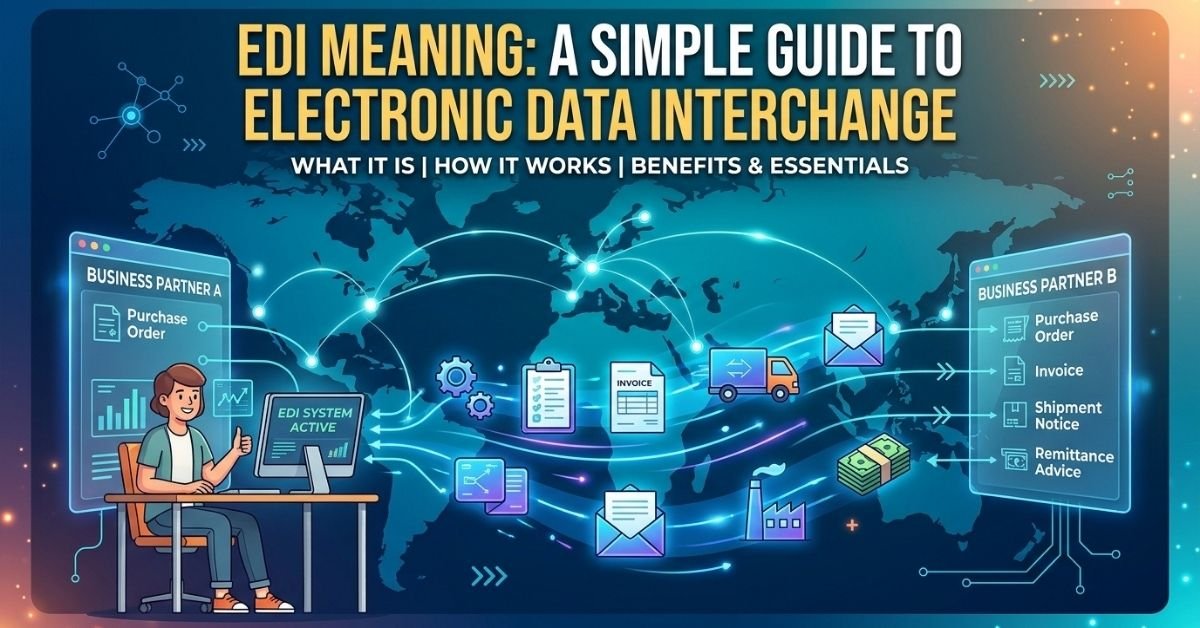
In today’s digital world, businesses need fast, reliable, and accurate ways to exchange information. Whether a company sells products online, manages a warehouse, manufactures goods, or supplies products to retailers, sharing business documents is an essential part of daily operations. Traditional methods, such as printing invoices, sending purchase orders by email, and manually entering information into computer systems, can consume valuable time and increase the risk of mistakes. This is where Electronic Data Interchange, commonly known as EDI, becomes useful.
EDI helps businesses exchange important documents directly between computer systems using agreed electronic formats. Instead of relying on paper documents or manually processing every transaction, organizations can automate many routine business activities. This makes communication between suppliers, manufacturers, distributors, retailers, and other trading partners more efficient.
If you are new to this technology, understanding EDI meaning is a useful first step toward learning how modern businesses manage orders, invoices, shipments, and other commercial transactions. This guide explains what EDI stands for, how it works, its common document types, its benefits and limitations, and how organizations can use it to improve their business processes.
What Is EDI Meaning?
EDI stands for Electronic Data Interchange. It refers to the computer-to-computer exchange of standardized business documents between two or more organizations. The information is transferred electronically in a structured format that the receiving system can understand and process.
In simple terms, EDI allows businesses to send and receive business documents automatically instead of exchanging paper forms or manually transferring information from one system to another.
For example, imagine that a retailer needs to purchase 500 products from a supplier. Without EDI, the retailer might prepare a purchase order, send it through email, and wait for the supplier to review the document. The supplier may then enter the order details into its own business software.
With EDI, the retailer’s system can generate a standardized electronic purchase order and send it directly to the supplier’s system. The supplier’s software can receive the information, interpret the order, and use it to begin processing the request.
The entire process can require much less manual work, depending on how the systems are configured.
The important point is that EDI is not simply about sending files electronically. It involves exchanging information in a predefined format that both parties have agreed to use. This standardized structure allows different business systems to communicate more consistently, even when the organizations use different software.
What Does Electronic Data Interchange Mean?
To understand the full meaning of EDI, it helps to examine the three words that make up the term.
Electronic means that information is created, transmitted, received, or processed through digital systems rather than relying exclusively on physical documents.
Data refers to the information contained in a business transaction. Examples include product descriptions, item numbers, quantities, prices, delivery addresses, invoice totals, and payment terms.
Interchange means exchanging information between parties. In an EDI environment, this exchange usually takes place between computer applications belonging to separate organizations.
When these three concepts are combined, Electronic Data Interchange describes a method of exchanging structured business information electronically between computer systems.
For example, when a manufacturer sends an electronic shipping notice to a retailer, the message may include the order reference, products being shipped, quantities, shipment details, and expected delivery information. If the message follows the agreed EDI standard and requirements, the retailer’s system can process the information without someone having to retype every detail.
This approach is particularly useful when businesses exchange large numbers of similar documents regularly.
How Does EDI Work?
EDI works by converting business information into a standardized electronic format, transmitting it to another organization, and allowing the receiving system to interpret and process it. Although the exact process depends on the software, document type, and communication method, most EDI transactions follow a similar sequence.
1. A Business Transaction Begins
The process starts when a business activity creates a need to exchange information. This might happen when a retailer places an order, a supplier prepares an invoice, or a warehouse dispatches a shipment.
For example, a retailer may discover that its stock of a particular product is running low. Its inventory or purchasing system can create an order containing the product identification, requested quantity, supplier details, and delivery information.
2. Business Information Is Converted Into an EDI Format
The information must be arranged according to a format that the trading partners have agreed to use. EDI software performs this conversion through a process commonly called mapping or translation.
Mapping connects information in a company’s internal system with the appropriate fields in an EDI document. For example, an internal product code, order number, quantity, and delivery address must be placed in the correct locations in the outgoing message.
The resulting document follows the required EDI standard and any additional rules established between the trading partners.
3. The EDI Document Is Transmitted
After the document is prepared, it is sent to the receiving organization through an agreed communication method. Depending on the arrangement, this could involve a value-added network, secure file transfer, or an internet-based connection.
The chosen method depends on the organizations’ technical requirements, security policies, trading relationships, and transaction volumes.
4. The Receiving System Interprets the Information
The receiving organization’s EDI software retrieves the document and checks whether it follows the expected structure and rules. If the message passes the necessary checks, the software translates the standardized information into a format that the receiving business application can use.
For example, a supplier’s order management system may receive a purchase order and use its details to create a sales order.
If the document contains missing information, incorrect codes, or formatting problems, the receiving system may reject it or send an error message for investigation.
5. The Transaction Continues
Once the information has been processed, the receiving organization can take the next business action. Depending on the transaction, this may involve confirming an order, preparing goods, scheduling a delivery, or issuing an invoice.
A separate EDI document may communicate the next step. For instance, a supplier might send an order acknowledgment or a shipping notice to the retailer.
This creates a more connected process in which information can move between organizations as a transaction progresses.
EDI Process at a Glance
| Step | What Happens | Practical Example |
|---|---|---|
| Transaction begins | A business system creates a document. | A retailer orders products. |
| Data mapping | Information is arranged in the required EDI structure. | Product codes and quantities are mapped into a purchase order. |
| Transmission | The electronic document is sent to the trading partner. | The order is transmitted to the supplier. |
| Validation and translation | The receiving system checks and interprets the message. | The supplier’s software validates the order. |
| Business processing | The information is used to complete the next task. | The supplier schedules order fulfillment. |
| Follow-up communication | Another electronic document may be exchanged. | The supplier sends a shipping notice. |
Not every EDI transaction follows precisely the same sequence. Some organizations exchange documents in batches, while others process messages more frequently. The main objective remains the same: to exchange structured business information reliably and reduce unnecessary manual handling.
Common Types of EDI Documents
EDI can support many different types of business documents. The documents used by an organization depend on its industry, trading partners, and business requirements.
Some messages support purchasing, while others help companies manage shipping, invoicing, inventory, payments, or order confirmations.
Understanding these document types makes it easier to see how EDI fits into everyday business operations.
1. EDI Purchase Order
A purchase order communicates a buyer’s request to purchase products or services from a supplier. It typically includes product identifiers, quantities, prices, delivery details, and order references.
For example, a supermarket may send a purchase order to a food distributor when it needs additional stock. The distributor can use the information to prepare and fulfill the order.
2. EDI Invoice
An EDI invoice communicates billing information electronically. It may include the invoice number, purchase order reference, product details, quantities, prices, taxes, and total amount due.
Instead of manually entering invoice information, the receiving business may be able to import it directly into its accounting or enterprise resource planning system.
3. EDI Order Acknowledgment
An order acknowledgment informs the buyer that the supplier has received or reviewed an order. Depending on the message and business arrangement, it may confirm the order or communicate changes that need attention.
This helps both parties understand the status of a transaction.
4. EDI Advance Ship Notice
An advance ship notice, often called an ASN, provides information about a shipment before the goods arrive. It can identify the products being shipped, their quantities, shipment references, and expected arrival information.
Retailers and warehouses can use this information to prepare for incoming deliveries and improve receiving operations.
5. EDI Shipping Instructions
Shipping-related EDI messages can communicate instructions or information needed to arrange the movement of goods. Depending on the industry and standard, these messages may cover transport requirements, shipment details, or delivery arrangements.
They help coordinate activities among suppliers, carriers, warehouses, and customers.
6. EDI Payment and Remittance Information
EDI can also support payment-related communication. For example, a buyer may send remittance information explaining which invoices are being paid and how the payment should be allocated.
This can help accounting teams reconcile payments with outstanding invoices.
Common EDI Documents and Their Purposes
| EDI Document | Main Purpose | Example User |
|---|---|---|
| Purchase order | Requests goods or services. | Retailer or manufacturer |
| Invoice | Communicates billing details. | Supplier or service provider |
| Order acknowledgment | Confirms receipt or communicates the status of an order. | Supplier |
| Advance ship notice | Provides shipment details before delivery. | Supplier or distributor |
| Shipping-related message | Communicates information needed for transportation or delivery. | Logistics provider |
| Remittance advice | Explains how a payment relates to invoices. | Buyer or accounts payable team |
| Inventory advice | Communicates relevant inventory information. | Warehouse or retailer |
The exact name, purpose, and structure of each document depend on the EDI standard and trading partners’ requirements. Not every organization uses every document type.
Real-World Examples of EDI
EDI can seem complicated when described only in technical terms. However, its practical purpose becomes easier to understand when you look at how businesses use it.
Example 1: EDI in Retail
Consider a clothing retailer that operates several stores and an online shop. The company regularly purchases clothing from different suppliers and needs accurate information about orders, shipments, and invoices.
Without EDI, employees may need to prepare purchase orders, email them to suppliers, check order confirmations, and manually enter invoice information into accounting software.
With EDI, the retailer can exchange standardized purchase orders, receive order-related messages, and process electronic invoices through connected systems.
As a result, employees may spend less time handling repetitive paperwork and more time managing stock, assisting customers, and resolving exceptions.
Example 2: EDI in Manufacturing
A manufacturer depends on a steady supply of raw materials and components to keep production running. Delays in purchasing or inaccurate order information can disrupt manufacturing schedules.
EDI can help the manufacturer exchange purchase orders, delivery schedules, shipping information, and invoices with its suppliers.
For example, if a factory needs 2,000 components for an upcoming production run, its purchasing system can send a standardized order to the supplier. The supplier can process the order and communicate relevant shipment details electronically.
When implemented effectively, this approach can improve coordination between production planning, procurement, and supply chain teams.
Example 3: EDI in Logistics
Logistics companies coordinate shipments between suppliers, warehouses, carriers, customs services, and customers. Each shipment may involve multiple documents and several organizations.
EDI helps these parties exchange structured information about consignments, shipping instructions, shipment status, and other transport-related activities.
For instance, a freight provider may receive shipment information electronically and use it to support transport planning. Another system may process related delivery or customs information according to the applicable requirements.
EDI does not eliminate every logistical challenge, but it can reduce the delays associated with manual document handling.
Example 4: EDI in E-Commerce
Online retailers often manage large numbers of orders while coordinating with suppliers, fulfillment centers, and delivery partners.
EDI can connect these businesses by automating exchanges of purchase orders, invoices, shipment notices, and other standardized messages.
Suppose an online retailer sells products supplied by an external distributor. The retailer can send an order electronically, while the distributor can transmit shipment details when the goods are dispatched.
This improves information sharing and can help both businesses manage customer orders more efficiently.
Example 5: EDI in Healthcare
Healthcare organizations exchange administrative and financial information with insurers, providers, laboratories, and other organizations. In the United States, certain healthcare transactions use standardized electronic formats under applicable regulations.
EDI-related standards can support transactions such as insurance claims, claim status inquiries, and payment-related communications.
The exact requirements depend on the country, transaction type, and applicable regulations. Healthcare organizations must also consider privacy, security, and compliance when exchanging sensitive information.
What Are the Main Benefits of EDI?
Businesses adopt EDI because it can make recurring document exchanges faster, more consistent, and easier to manage. The value depends on how frequently documents are exchanged, how well systems are integrated, and how accurately the implementation reflects the organization’s needs.
Faster Business Transactions
Manual document processing often involves several steps, including preparing forms, sending messages, reviewing information, and entering data into another system.
EDI can automate many of these activities. When documents are exchanged and processed electronically, businesses may be able to handle orders and invoices more quickly.
This can be particularly valuable for organizations that process hundreds or thousands of transactions.
Fewer Manual Data Entry Errors
Typing the same information into multiple systems creates opportunities for mistakes. An employee might enter an incorrect product code, reverse two digits in an order number, or enter the wrong quantity.
EDI reduces the need to re-enter information manually and uses structured formats to help maintain consistency.
However, EDI does not guarantee perfect data. Incorrect source information, invalid mappings, and configuration problems can still lead to errors.
Lower Administrative Costs
Paper-based processes can involve printing, postage, document storage, manual processing, and employee time.
By automating recurring document exchanges, businesses may reduce some of these expenses. Savings can be especially significant when trading partners exchange large volumes of standardized documents.
Nevertheless, EDI software, integration, testing, and ongoing support also involve costs. Organizations should evaluate total implementation and operating expenses rather than assuming that EDI will always be cheaper.
Improved Business Relationships
Reliable information exchange helps buyers, suppliers, and service providers coordinate their activities.
When both parties use compatible EDI processes, they can exchange order details and shipment information in a more consistent manner. This can reduce misunderstandings and make routine transactions easier to manage.
Clear procedures for handling rejected messages and resolving discrepancies are also important for maintaining strong business relationships.
Better Inventory Management
Accurate and timely order and shipment information can help companies understand what they have ordered, what suppliers have dispatched, and what is expected to arrive.
When EDI is integrated with inventory and warehouse systems, it can support replenishment planning and receiving activities.
For example, a distributor may use incoming order and shipment information to prepare warehouse space and coordinate stock availability.
EDI alone does not guarantee optimal inventory levels, but it can improve the quality and availability of information used to make inventory decisions.
Greater Operational Visibility
Electronic messages can create records of business transactions and their processing status. Depending on the EDI platform, organizations may be able to track when a message was sent, received, accepted, or rejected.
This information can help staff identify delays and investigate problems.
Visibility depends on the capabilities of the EDI solution, the acknowledgments exchanged, and the monitoring procedures used by the business.
Less Paperwork
EDI reduces reliance on printed documents by allowing businesses to exchange structured electronic information.
This can simplify document management and reduce paper consumption. It may also make information easier to retrieve when systems are properly configured.
For businesses that handle large numbers of recurring transactions, moving away from paper can be a meaningful operational improvement.
Advantages and Disadvantages of EDI
Although EDI provides important benefits, it also introduces technical and operational requirements. Businesses should understand both sides before deciding whether to implement it.
| Advantages | Disadvantages |
|---|---|
| Automates recurring business document exchanges. | Initial implementation can require significant effort. |
| Reduces repetitive manual data entry. | Incorrect data mapping can cause transaction errors. |
| Can shorten order and invoice processing times. | Trading partners must agree on compatible formats and requirements. |
| Supports more consistent business communication. | Some systems require specialist knowledge to maintain. |
| Can reduce paper handling and administrative costs. | Software, integration, and service fees may apply. |
| Improves transaction tracking when suitable monitoring is available. | Errors or connection failures still require investigation. |
| Supports integration between business applications. | Changes to business processes may require configuration and testing. |
The most important consideration is whether the benefits of automation justify the cost and complexity of implementation. Businesses with frequent, repetitive transactions often have stronger reasons to adopt EDI than organizations that exchange only a small number of documents.
What Are the Different EDI Standards?
EDI depends on standardized message structures so that different computer systems can interpret exchanged information consistently. Several standards are used across industries and regions.
The appropriate standard depends on the organization’s industry, trading partners, geographic requirements, and existing systems.
ANSI ASC X12
ANSI ASC X12 is a widely used EDI standards framework, particularly in North America. It supports business transactions involving purchasing, transportation, healthcare, finance, and other areas.
Different transaction sets represent different business purposes. For example, the X12 850 transaction set is commonly used for purchase orders, while the X12 810 transaction set is used for invoices.
Organizations must use the appropriate version and implementation requirements agreed upon with their trading partners.
UN/EDIFACT
UN/EDIFACT stands for United Nations Electronic Data Interchange for Administration, Commerce and Transport. It is an international set of standards developed to support the electronic exchange of structured business messages.
It is used in areas such as international trade, transportation, logistics, and commercial transactions.
Its standardized message structures help organizations exchange information across national borders and between different business systems.
GS1 EANCOM
GS1 EANCOM is a set of standardized electronic business messages based on UN/EDIFACT. It is used in sectors such as retail and consumer goods to support consistent exchanges of commercial information.
It can help trading partners exchange information about orders, deliveries, invoices, and related transactions.
GS1 XML
GS1 XML provides standardized XML-based formats for exchanging business information. It is another option within the GS1 standards environment and can be used to support electronic business communication.
Its XML structure may be suitable for organizations whose systems are designed to process XML-based messages.
Common EDI Standards at a Glance
| Standard | General Use | Typical Context |
|---|---|---|
| ANSI ASC X12 | Structured business transaction messages. | North American retail, healthcare, manufacturing, and transportation |
| UN/EDIFACT | International electronic business communication. | Global trade, shipping, and logistics |
| GS1 EANCOM | Standardized commercial messages based on EDIFACT. | Retail and consumer goods |
| GS1 XML | XML-based electronic business messages. | Supply chain and trading-partner integration |
These standards are not interchangeable in every situation. Trading partners must agree on the required standard, version, message type, and implementation rules before exchanging production documents.
What Is the Difference Between EDI and API?
EDI and application programming interfaces, commonly called APIs, both allow computer systems to exchange information. However, they are designed around different approaches to communication and integration.
EDI typically uses predefined business document structures and agreed transaction rules. It is particularly useful for recurring, structured transactions between established trading partners.
APIs allow software applications to communicate through defined interfaces. They often support more flexible interactions, including requests for current information and immediate updates between connected systems.
For example, a retailer might use EDI to send purchase orders and receive invoices from a supplier while using an API to retrieve live inventory information from a warehouse application.
The two technologies can work together rather than competing directly.
| Feature | EDI | API |
|---|---|---|
| Main purpose | Exchange standardized business documents. | Allow software applications to communicate and exchange data or request services. |
| Data structure | Uses agreed EDI message formats. | Uses an interface contract and supported data formats, often JSON or XML. |
| Communication pattern | Can use batch processing or more frequent exchanges. | Often supports request-response or event-driven communication. |
| Common applications | Purchase orders, invoices, shipping notices, and other business transactions. | Live inventory checks, application integrations, service requests, and data synchronization. |
| Integration requirements | Requires agreed message standards and trading-partner mappings. | Requires compatible API interfaces, authentication, and integration logic. |
| Typical strength | Consistent handling of recurring standardized transactions. | Flexible interaction between connected applications. |
Neither option is universally better. The right choice depends on the business process, partner requirements, transaction volume, response-time needs, and available technology. Some organizations use EDI and APIs together to support different parts of their operations.
What Is the Difference Between EDI and Email?
EDI and email can both transmit information electronically, but they handle business data differently.
Email is primarily designed for communication between people. A person can write a message, attach a spreadsheet, or send a PDF invoice. The recipient may then need to open the attachment and manually transfer the relevant information into a business application.
EDI is designed to exchange structured business messages that compatible systems can process according to predefined rules.
For example, a supplier might email a purchase order as a PDF. An employee at the supplier’s company may need to review the document and enter the details into an order management system.
With EDI, the buyer’s system can send a standardized purchase order that the supplier’s system can interpret automatically, provided the integration is configured correctly.
Email remains useful for discussions, unusual requests, and exceptions that require human judgment. EDI is particularly useful for repetitive transactions where structured, consistent information is essential.
What Is an EDI System?
An EDI system is the combination of software, connections, configuration rules, and supporting processes that enable organizations to exchange standardized business documents.
A typical EDI environment may include several components that work together.
Business applications create or consume transaction data. These applications may include enterprise resource planning systems, accounting platforms, order management software, and warehouse management systems.
EDI translation software converts information between a company’s internal data structures and the required EDI message format.
Data mapping rules determine how information in one system corresponds to fields in another. These rules help ensure that product numbers, quantities, addresses, and other values are placed in the correct locations.
Communication services transfer messages between trading partners using an agreed method, such as secure file transfer or a managed network service.
Validation and monitoring tools check message structure, report errors, and help staff investigate unsuccessful transactions.
Some organizations operate their own EDI infrastructure, while others use a managed EDI provider that handles part of the technical work.
The best arrangement depends on transaction volume, internal expertise, security requirements, budget, and the number of trading partners involved.
What Is an EDI Provider?
An EDI provider is a company that supplies software, infrastructure, integration services, or technical support for electronic data interchange.
Businesses may work with an EDI provider when they do not want to build and maintain every component of the system themselves.
Depending on the service, a provider may help configure trading partners, map business data, validate messages, manage communications, monitor transactions, and resolve technical problems.
Some providers offer cloud-based platforms that allow businesses to manage their EDI operations through an online service. Others offer specialized integration services for particular industries or enterprise systems.
Choosing a provider requires more than comparing subscription prices. Organizations should also evaluate supported standards, integration capabilities, security controls, monitoring tools, customer support, scalability, and the ability to meet their trading partners’ requirements.
A provider can simplify implementation, but the business remains responsible for ensuring that its transaction data and business processes are accurate.
Is EDI Secure?
EDI can support secure business communication, but its actual security depends on the complete system and the controls used to operate it.
Businesses may protect EDI transactions through encryption, authentication, access controls, secure transmission methods, activity logging, and procedures for managing security incidents.
For example, a company may use a secure file transfer connection to exchange invoices with a supplier and restrict access to authorized systems and employees.
However, using EDI does not automatically make every transaction secure. Poorly configured connections, weak credentials, excessive access permissions, or insufficient monitoring can expose business information to risk.
Organizations should assess the sensitivity of the information they exchange and apply appropriate security measures. They should also review their provider’s security practices, backup procedures, incident response arrangements, and contractual responsibilities.
Where personal, financial, or regulated information is involved, additional legal and compliance requirements may apply.
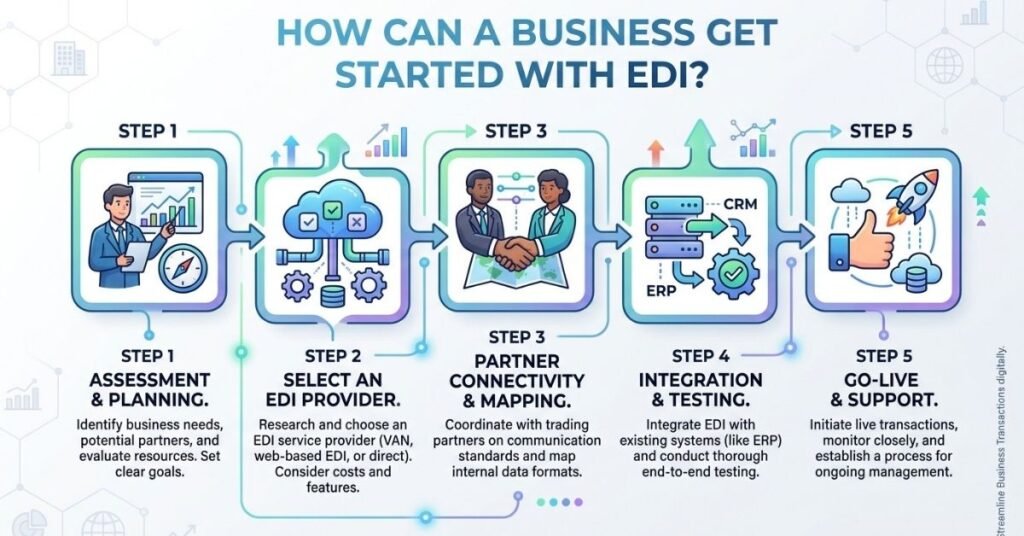
How Can a Business Get Started With EDI?
Implementing EDI involves more than installing software. A successful project requires clear business requirements, coordination with trading partners, accurate data mapping, testing, and ongoing monitoring.
Identify Business Requirements
The first step is to understand which business processes would benefit most from automation.
A company might begin with purchase orders and invoices because these documents are exchanged frequently. Another business might prioritize shipping notices or inventory-related messages.
Identifying the main objectives helps the organization select the right solution and establish measurable expectations.
Review Trading-Partner Requirements
Businesses often need to follow specific EDI requirements established by their customers, suppliers, or other partners.
These requirements may specify the EDI standard, message version, document types, communication method, mandatory fields, and acknowledgment procedures.
Understanding these details early can prevent compatibility problems later.
Select an EDI Solution
An organization can consider an in-house system, a managed service, or a cloud-based EDI platform.
The decision should account for the company’s technical expertise, transaction volume, budget, integration needs, security requirements, and expected future growth.
A small business may prefer a managed solution, while a larger enterprise with complex integration requirements may need a more customized environment.
Integrate Existing Business Software
EDI generally needs to exchange information with the organization’s existing applications.
For example, a purchasing system may generate an outgoing order, while an accounting system receives invoice data.
The integration should ensure that information moves correctly between internal applications and the EDI platform.
Test Before Going Live
Testing is an essential part of implementation. Businesses should verify that outgoing messages contain the correct information and that incoming messages are interpreted properly.
Testing should cover ordinary transactions, missing information, invalid values, rejected messages, and other realistic situations.
Where required, trading partners may need to approve the test results before production transactions begin.
Monitor and Improve Performance
After implementation, the organization should monitor transaction processing, message rejections, communication failures, and unresolved errors.
It should also review whether the system is delivering the expected improvements in processing time, accuracy, and administrative effort.
Regular monitoring helps identify problems early and keeps the EDI process aligned with changing business requirements.
Also Read! DBQ Meaning: What Does DBQ Stand For and How Is It Used?
Common EDI Challenges and How to Address Them
EDI can improve business operations, but implementation and maintenance may present several challenges.
One common issue is incompatible data formats. Even when two companies use the same general EDI standard, they may have different requirements for specific fields, codes, or document versions. Businesses can address this by documenting partner requirements carefully and testing their mappings before exchanging live transactions.
Another challenge is poor data quality. If the source system contains an incorrect product number, address, or quantity, the EDI message may transmit that incorrect information accurately. Data validation and well-maintained master records can help reduce this risk.
Integration complexity can also create difficulties, especially when a company operates multiple business applications. Clear integration design, realistic testing, and documented error-handling procedures can make the system easier to maintain.
Some businesses encounter high initial costs when they need specialized software, external consultants, or extensive customization. Comparing managed and in-house options can help organizations find a solution appropriate for their scale and budget.
Finally, transaction failures can occur because of network problems, invalid messages, configuration changes, or unavailable systems. Monitoring, alerts, acknowledgments, and documented recovery procedures help teams identify and resolve these problems.
The key to reliable EDI is not simply automating document transmission. It is building a dependable process for validating information, managing exceptions, and coordinating with trading partners.
Who Uses EDI?
EDI is used by organizations that exchange structured business documents regularly and need consistent communication between their computer systems.
Large retailers use it to coordinate purchasing, invoicing, and deliveries with suppliers. Manufacturers use it to exchange orders and supply chain information with component providers. Logistics companies use it to communicate shipment and transportation details. Distributors use it to manage transactions with customers and vendors.
Healthcare organizations may use standardized electronic transactions for administrative and financial processes, subject to applicable requirements.
Financial services, automotive businesses, wholesalers, and other industries may also use EDI when their business partners and operational processes call for standardized document exchange.
EDI is not limited to large enterprises. Small and medium-sized businesses can also use it, particularly when important customers or suppliers require electronic transactions. The most suitable solution depends on the company’s needs and the level of integration required.
Is EDI Still Relevant Today?
Yes, EDI remains relevant because many businesses continue to depend on standardized transactions to coordinate purchasing, inventory, shipping, invoicing, and payments.
Although cloud computing, APIs, and modern integration platforms have expanded the ways applications communicate, established EDI workflows remain important in many supply chains.
One reason is that businesses often have long-standing relationships with trading partners and established processes built around specific EDI standards. Replacing those systems may require considerable coordination and investment.
Modern EDI solutions can also integrate with cloud applications, enterprise software, and other digital services. This allows organizations to improve their existing processes without necessarily abandoning standardized electronic documents.
The technology continues to be useful where consistency, compatibility, and dependable processing of recurring business transactions are important.
The decision to use EDI should depend on the business problem being solved rather than on whether a technology is old or new. For many organizations, EDI remains a practical part of a broader digital integration strategy.
Also Read! FCFS Meaning: What Does FCFS Stand For?
Understanding common EDI abbreviations can help beginners learn how electronic business transactions work. These terms are frequently used in supply chain management, retail, logistics, manufacturing, and business software integration.
| Abbreviation | Full Form | Meaning |
|---|---|---|
| EDI | Electronic Data Interchange | Electronic exchange of standardized business documents between computer systems. |
| PO | Purchase Order | A document used by a buyer to request goods or services from a supplier. |
| ASN | Advance Ship Notice | A message that provides shipment details before goods arrive. |
| ERP | Enterprise Resource Planning | Software that helps businesses manage operations such as finance, inventory, and purchasing. |
| API | Application Programming Interface | An interface that allows different software applications to communicate. |
| XML | Extensible Markup Language | A structured format for storing and exchanging data. |
| X12 | ANSI ASC X12 | A widely used set of EDI standards, especially in North America. |
| EDIFACT | Electronic Data Interchange for Administration, Commerce and Transport | An international set of standards for exchanging structured business messages. |
| VAN | Value-Added Network | A managed service that can facilitate the exchange of electronic business documents between trading partners. |
| SFTP | SSH File Transfer Protocol | A secure protocol for transferring files between computer systems. |
| ERP | Enterprise Resource Planning | A system used to integrate and manage different business processes. |
| WMS | Warehouse Management System | Software used to manage warehouse activities, inventory, and order fulfillment. |
| TMS | Transportation Management System | Software used to plan, manage, and track transportation operations. |
| INV | Invoice | A billing document that specifies goods or services provided and the amount due. |
| ACK | Acknowledgment | A message or response indicating that information has been received or processed, depending on the context. |
| AP | Accounts Payable | The money a business owes to its suppliers or vendors. |
| AR | Accounts Receivable | The money customers owe to a business. |
| 850 | EDI Purchase Order | An ANSI X12 transaction set commonly used to communicate purchase orders. |
| 810 | EDI Invoice | An ANSI X12 transaction set commonly used to communicate invoices. |
| 856 | EDI Advance Ship Notice | An ANSI X12 transaction set used to provide shipment information. |
Knowing these abbreviations makes it easier to understand EDI documentation, communicate with trading partners, and follow electronic transactions across business systems. Although some abbreviations are widely used, their exact meaning can vary depending on the industry or software platform.
Frequently Asked Questions About EDI Meaning
1. What does EDI stand for?
EDI stands for Electronic Data Interchange. It is a method of exchanging standardized business documents electronically between computer systems.
2. What is EDI in simple words?
EDI allows businesses to send and receive structured documents, such as purchase orders and invoices, directly between computer systems. It reduces the need for paper documents and repetitive manual data entry.
3. What is an example of EDI?
A retailer sends a purchase order electronically to a supplier. The supplier’s EDI system receives the order, converts it into information its business software can process, and uses it to begin fulfilling the request.
4. What is the main purpose of EDI?
The main purpose of EDI is to make business document exchange more standardized, efficient, and suitable for automated processing between organizations.
5. Is EDI a software program?
EDI is not one specific software program. It refers to the standards and methods used for exchanging structured electronic business documents. An EDI solution typically includes software, integration tools, communication services, and supporting processes.
6. What is an EDI transaction?
An EDI transaction is a structured electronic business message exchanged between systems. Examples include a purchase order, invoice, order acknowledgment, or shipping notice.
7. What is an EDI number?
The phrase “EDI number” can mean different things depending on the context. It may refer informally to a transaction reference, a document identifier, or a number associated with a particular EDI record. There is no single universal number called an EDI number that applies to every EDI system.
8. What is the difference between EDI and electronic invoicing?
Electronic invoicing refers to issuing, transmitting, or receiving invoices electronically. EDI is a broader method of exchanging standardized business documents and can include invoices as well as purchase orders, shipping notices, and other messages.
An electronic invoice is not necessarily an EDI invoice. The distinction depends on the format and process used to exchange it.
9. Does EDI require the internet?
No. EDI does not inherently require a public internet connection. Organizations can use different communication methods, including managed networks and internet-based connections. The appropriate option depends on their technical and security requirements.
10. Can small businesses use EDI?
Yes. Small businesses can use EDI through managed services, cloud platforms, or other suitable solutions. It may be particularly useful when a business regularly exchanges documents with customers or suppliers that require EDI.
11. Is EDI the same as an API?
No. EDI focuses on exchanging standardized business messages, while APIs allow software applications to communicate through defined interfaces. Both can support business integration, and some organizations use them together.
12. What are the most common EDI documents?
Common examples include purchase orders, invoices, order acknowledgments, advance ship notices, shipping-related messages, and remittance advice. The exact documents depend on the industry and trading partners.
Conclusion
Understanding EDI meaning helps explain how businesses exchange important information without relying entirely on paper documents or manual data entry. EDI, or Electronic Data Interchange, enables organizations to transmit structured business documents between computer systems using agreed formats and rules.
From purchase orders and invoices to shipment notices and payment-related information, EDI supports many everyday business activities. When implemented properly, it can reduce repetitive administrative work, improve data consistency, speed up document processing, and strengthen coordination between trading partners.
However, successful implementation requires suitable software, accurate data mapping, compatible standards, secure communication, and clear procedures for handling errors. Businesses must also consider implementation costs and the requirements of their trading partners.
Ultimately, EDI is more than a way to send documents electronically. It is a method of connecting business processes so that organizations can exchange information more consistently and manage transactions more efficiently. Whether a company operates in retail, manufacturing, logistics, healthcare, or another industry, EDI can be a valuable part of its digital operations when it fits the organization’s needs.