ALR Meaning in Text: Definition, Uses, and Examples
Key Takeaways
- ALR means “alright” in most text messages and online conversations.
- People use ALR to agree with someone, acknowledge information, confirm plans, or accept a suggestion.
- ALR is commonly seen in casual chats on Snapchat, TikTok, Instagram, WhatsApp, and other messaging platforms.
- The meaning of ALR depends on context. It can sound friendly, neutral, or occasionally reluctant, but it is not inherently rude.
- ALR is similar to “okay” and “aight,” although these expressions have slightly different writing styles and uses.
- The abbreviation is suitable for informal conversations but is generally best avoided in professional emails and formal writing.
Introduction
Online conversations move quickly, and people often look for simple ways to express themselves without typing complete sentences. That is one reason short expressions such as ALR have become familiar in text messages, social media comments, and private chats. You might receive it after suggesting a meeting, explaining something to a friend, or asking someone to complete a task. Although the message contains only three letters, it can communicate several different ideas depending on the situation.
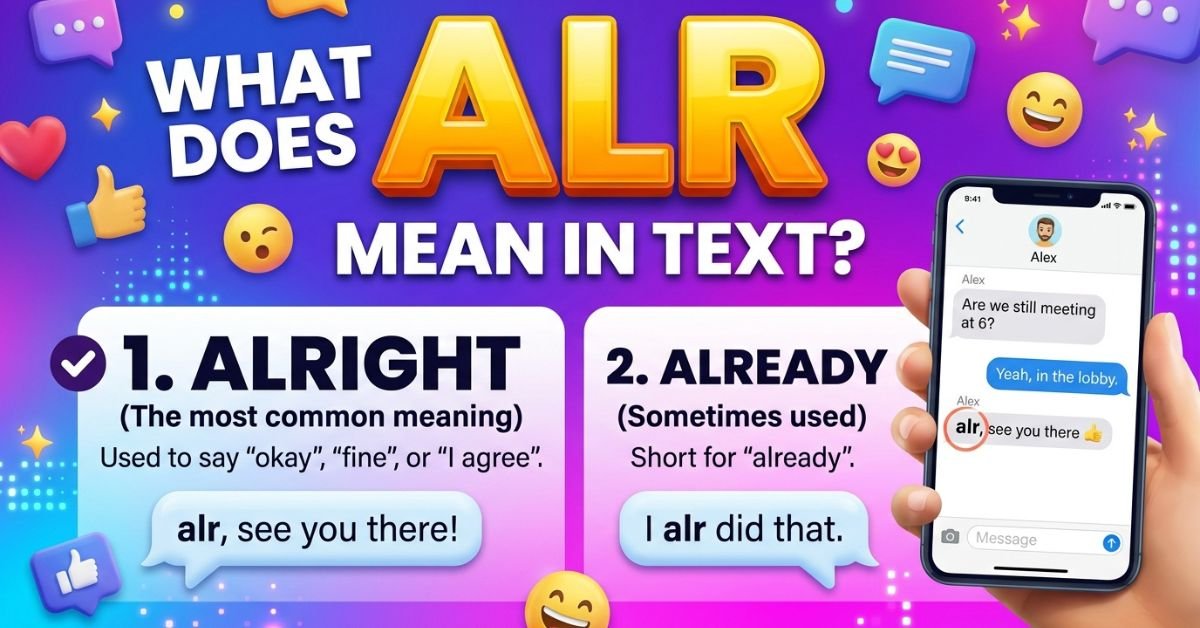
The most common meaning of ALR in text is “alright.” People use it when they understand something, agree with a suggestion, accept a decision, or want to acknowledge a message without writing a lengthy response. For example, if your friend says, “I’ll meet you outside the library at 4,” replying “Alr, see you there” confirms that you understand the arrangement.
However, interpreting internet slang is not always just about knowing its definition. Tone, context, and the relationship between the people involved can also affect how a message is understood. This guide explains what ALR means, how people use it, how to respond to it, and which related abbreviations you may encounter in everyday digital communication.
What Does ALR Mean in Text?
ALR is an informal abbreviation of “alright.” It is commonly used in texting as a shorter way to express agreement, acceptance, or understanding. Instead of typing the complete word, someone can write ALR to acknowledge what another person has said and keep the conversation moving.
For instance, imagine that a classmate messages you, “The assignment deadline has been changed to Friday.” You could reply, “Alr, thanks for telling me.” Your response communicates that you have received the update and understand the new deadline.
ALR can also appear as a standalone reply. If someone asks, “Can we talk after lunch?” and you respond with “alr,” the other person will usually understand that you are okay with the suggestion. The exact interpretation depends on the question and the surrounding conversation.
The abbreviation is informal, so it is most appropriate in relaxed conversations. Although many people recognize it online, not everyone uses the same texting vocabulary. When clarity is especially important, writing “alright” or “okay” can be a better choice.
What Does ALR Stand For?
In everyday internet slang, ALR generally stands for “alright.” The word itself can communicate that something is acceptable, that a person understands a situation, or that they agree to a proposed arrangement.
The meaning can shift slightly according to the way it is used. Consider the difference between these messages: “Alr, I’ll do it” and “Alr then.” The first sounds like a clear acknowledgment followed by an intention to act. The second may communicate simple acceptance, but in certain conversations it could also suggest disappointment or reluctance.
This does not mean ALR has several completely separate meanings in ordinary texting. Instead, the underlying idea of “alright” is flexible enough to fit different conversational situations.
In specialized contexts, the same letters may be used as an acronym for something unrelated to texting slang. If you encounter ALR in a technical document or industry-specific discussion, consider the subject before deciding what it means. In everyday chats, however, “alright” is generally the most likely interpretation.
Why Do People Use ALR Instead of Alright?
The main reason people use ALR is convenience. Digital conversations often involve quick questions, short updates, and rapid exchanges. Typing an abbreviation can save a little time and help a conversation feel less formal.
Another reason is conversational style. Friends who regularly message each other may develop familiar ways of responding. One person might write “okay,” another might prefer “alr,” and someone else might use “sure.” These choices help establish a casual communication style without changing the basic message.
ALR can also be useful when a full explanation is unnecessary. If a friend tells you that they have arrived at your meeting place, a short acknowledgment may be enough. There is no need to write a complete paragraph when the information requires only a quick response.
Still, shorter is not always better. A brief message can leave room for misunderstanding when the situation involves important details or strong emotions. Adding a few words can make your meaning clearer without making the conversation unnecessarily formal.
Common Uses of ALR in Text Messages
ALR can serve different purposes depending on what the other person has said. Recognizing these uses makes it easier to understand the intended message.

1. Showing Agreement
People often use ALR when accepting a suggestion or agreeing to a plan. For example, if a friend asks whether you want to study together in the evening, replying “Alr, let’s meet at 6” communicates that the arrangement works for you.
2. Acknowledging Information
Sometimes the other person simply needs to know that you have received a message. If someone tells you that they have emailed an important document, replying “Alr, I’ll check it” acknowledges the update and indicates what you will do next.
3. Confirming Arrangements
ALR is also used when confirming a time, location, or other practical detail. A response such as “Alr, I’ll be outside at 8” confirms the arrangement in a casual way.
4. Accepting a Change
Plans do not always work out as expected. If a friend needs to postpone a meeting, “Alr, we can go tomorrow instead” shows that you accept the change.
5. Ending a Conversation
ALR may be used near the end of a conversation when there is nothing else to discuss. For example, “Alr, talk to you later” acknowledges the other person’s message and provides a natural ending.
6. Responding Casually
Some people use ALR as a quick reaction to everyday comments. When a friend says, “I finally finished that game,” replying “Alr, nice!” may acknowledge the update, although adding a question about the game would show more interest and encourage the conversation to continue.
ALR Meaning on Snapchat, TikTok, Instagram, and WhatsApp
The meaning of ALR generally stays the same across social media platforms. What changes is the kind of conversation in which it appears.
ALR Meaning on Snapchat
On Snapchat, ALR is commonly used in casual chats between friends. Someone might send it after receiving an invitation, responding to a snap, or discussing weekend plans. For example, “Alr, send me the picture when you can” means that the sender understands or accepts the request.
ALR Meaning on TikTok
TikTok users may use ALR in comments, captions, and direct messages. It can appear when someone acknowledges an opinion or responds to a suggestion. A comment such as “Alr, I see what you mean” communicates understanding. The surrounding words determine whether the response sounds sincere, humorous, or sarcastic.
ALR Meaning on Instagram
On Instagram, ALR may appear in direct messages when people discuss meetups, share updates, or respond to requests. If someone asks, “Can you send me the details tonight?” a reply such as “Alr, I’ll send them” acknowledges the request and indicates an intention to follow through.
ALR Meaning on WhatsApp
WhatsApp conversations often involve practical communication, including family updates, study groups, and arrangements with friends. ALR can be used to confirm a change in plans or acknowledge an important message. For example, “Alr, I’ll bring the documents tomorrow” confirms that the sender understands what needs to be done.
Does ALR Have a Different Meaning on Each Platform?
Not usually. The most common meaning remains “alright.” If a message seems unusual, pay attention to the surrounding conversation rather than assuming the platform gives the abbreviation a new definition.
ALR Meaning in Different Situations
A single abbreviation can communicate different intentions depending on the circumstances. The following table illustrates common interpretations.
| Text message | Likely meaning |
|---|---|
| “Alr, thanks for the update.” | Acknowledgment |
| “Alr, I’ll join you.” | Agreement |
| “Alr, see you at 5.” | Confirmation |
| “Alr, no worries.” | Acceptance or reassurance |
| “Alr then.” | Acceptance, possibly reluctant |
| “Alr bro 😂” | Casual acknowledgment |
| “Alr, I’ll take care of it.” | Understanding and willingness to act |
| “Alr, talk tomorrow.” | Conversation closure |
| “Alr, that works for me.” | Agreement with a proposal |
| “Alr, do what you think is best.” | Acceptance that may sound frustrated in context |
These examples represent common possibilities rather than strict rules. The words before and after ALR, as well as the history of the conversation, help determine the intended meaning.
ALR Meaning in Real-Life Texting Conversations
Looking at complete conversations makes the abbreviation easier to understand. Here are several realistic examples from everyday situations.
Example 1: Making weekend plans
Person A: “Are you free to go shopping on Saturday?”
Person B: “Alr, what time?”
In this example, Person B is accepting the idea and asking for an additional detail. ALR helps move the conversation toward making a specific plan.
Example 2: Discussing schoolwork
Person A: “Our presentation is due on Monday, so we need to finish the slides.”
Person B: “Alr, I’ll work on my part tonight.”
Here, the abbreviation acknowledges the information, while the rest of the reply explains the action Person B intends to take.
Example 3: Changing a meeting time
Person A: “Can we meet at 7 instead of 6?”
Person B: “Alr, 7 is fine.”
The reply clearly confirms that the new time is acceptable.
Example 4: Sharing an update
Person A: “I reached home safely.”
Person B: “Alr, glad you made it.”
ALR acknowledges the update, and the additional words communicate concern and friendliness.
Example 5: Accepting a request
Person A: “Please remind me to bring the book tomorrow.”
Person B: “Alr, I’ll remind you.”
The response indicates that Person B understands and accepts the request.
Example 6: Ending a conversation
Person A: “I need to sleep now. We can talk in the morning.”
Person B: “Alr, goodnight!”
Here, ALR acknowledges the decision and helps end the exchange naturally.
Example 7: Responding after a disagreement
Person A: “I think we should choose the other restaurant.”
Person B: “Alr then.”
This could indicate agreement, resignation, or mild disappointment. The message alone cannot establish which emotion Person B feels.
What Is the Difference Between ALR, Alright, and Aight?
ALR, alright, and aight are related expressions, but they differ in spelling and style.
| Term | Meaning | Typical style |
|---|---|---|
| ALR | Alright | Abbreviated, casual texting |
| Alright | Alright | Complete informal word |
| Aight | Alright or okay | Slang-style spelling |
| Okay / OK | Agreement or acknowledgment | Widely used in casual and formal settings |
| Sure | Willingness or agreement | Direct and conversational |
For example, “Alr, I’ll be there soon” and “Alright, I’ll be there soon” usually communicate the same idea. ALR is shorter, while alright is the complete word.
Aight is another informal expression associated with relaxed speech. It can sound more slang-oriented, depending on the speaker and context. Okay is generally more widely suitable across different situations, while sure often emphasizes willingness to do something.
These expressions may overlap in meaning, but they are not always identical in tone. Choosing one depends on your relationship with the other person and the type of conversation you are having.
ALR vs. K: Are They the Same?
ALR and K can both be used as short replies, but they have different origins. ALR is short for “alright,” while K is a shortened spelling of “okay.”
Both can acknowledge a message or indicate acceptance. However, some readers interpret a standalone “K” as abrupt because it provides very little context. ALR may feel slightly more conversational to some people, although this depends on individual texting habits.
For example, if someone writes, “I’ll send the pictures tonight,” replying “K” may be understood as simple acknowledgment. Replying “Alr, thanks!” communicates the same basic understanding while adding a polite expression.
Neither abbreviation is automatically rude. If you want your response to sound warmer, adding words such as “sounds good,” “thanks,” or “no problem” can make your intention easier to understand.
ALR is only one of many abbreviations used in digital conversations. The following terms can help you understand other common messages you may encounter in chats and social media comments.
| Abbreviation | Full form or meaning | Example |
|---|---|---|
| BTW | By the way | “BTW, are you coming?” |
| BRB | Be right back | “BRB, someone is calling me.” |
| IDK | I don’t know | “IDK what happened.” |
| IDC | I don’t care | “IDC which movie we watch.” |
| TBH | To be honest | “TBH, I liked the first one.” |
| NGL | Not gonna lie | “NGL, that was impressive.” |
| IMO | In my opinion | “IMO, this is the best choice.” |
| LMK | Let me know | “LMK when you’re ready.” |
| OMW | On my way | “OMW, see you soon.” |
| TTYL | Talk to you later | “I’m busy now, TTYL.” |
| NVM | Never mind | “NVM, I found it.” |
| RN | Right now | “I can’t talk RN.” |
| FR | For real | “That was funny, fr.” |
| IKR | I know, right? | “IKR, I was surprised too.” |
| WYD | What are you doing? | “Hey, wyd?” |
| WBU | What about you? | “I’m fine, wbu?” |
| GG | Good game | “GG, that was a close match.” |
| AFK | Away from keyboard | “I’m AFK for a few minutes.” |
| NP | No problem | “NP, happy to help.” |
| NTH | Nothing | Meaning can vary by community; check context. |
These expressions serve different purposes. ALR generally acknowledges or accepts something, while LMK requests information, BRB indicates a temporary absence, and TBH introduces an honest opinion. Understanding the distinctions helps you avoid confusing a reply with a request or an emotional expression.
Also Read! LYK Meaning in Text: What Does LYK Stand For in Chat?
Can ALR Sound Rude or Disrespectful?
ALR is not inherently rude. Many people use it as a neutral acknowledgment because they are busy, prefer short messages, or do not think a longer reply is necessary.
However, the same brief response may feel dismissive in a sensitive conversation. If someone tells you about a difficult day and receives only “alr,” they might feel that you have not understood the importance of what they shared. That reaction comes from the circumstances and expectations of the conversation, not from a fixed meaning of ALR.
Consider the difference between these replies:
“Alr, see you tomorrow!” sounds like a normal acknowledgment of a plan.
“Alr then” after a disagreement may be interpreted as reluctant acceptance, especially if the earlier conversation was tense.
Even so, neither example proves that the sender is annoyed. Some people naturally write brief messages regardless of their mood. When a conversation matters, it is better to consider the complete exchange or ask a respectful question than to assume that three letters reveal someone’s feelings.
Does ALR Mean Yes or Okay?
ALR can function like “yes” or “okay” when someone agrees to a request, accepts a suggestion, or confirms an arrangement. However, its direct expansion is “alright,” and its meaning may be closer to simple acknowledgment in some situations.
For example, if someone asks, “Can you bring your notebook tomorrow?” and you respond, “Alr,” they will probably understand that you agree. If someone says, “The meeting has been moved to Thursday,” your reply may simply indicate that you understand the update.
If you want to express enthusiastic agreement, consider adding a few words, such as “Alr, sounds great!” If you only need to acknowledge information, a simple “alr” may be sufficient.
What Does ALR Mean When a Girl or Guy Texts You?
When a girl or a guy sends ALR, the usual meaning is still “alright.” The abbreviation does not have a special romantic meaning simply because of the sender’s gender.
A person may use ALR to accept an invitation, acknowledge a message, confirm plans, or end a conversation. Whether the reply indicates friendliness, interest, irritation, or nothing more than acknowledgment depends on the context and the person’s normal communication style.
For example, “Alr, see you tomorrow” is generally a confirmation of plans. It should not automatically be interpreted as a sign of romantic interest or disinterest.
If you are trying to understand someone’s feelings, look at the broader pattern of communication rather than one short abbreviation. A single message cannot reliably establish what someone thinks or feels.
When Should You Avoid Using ALR?
ALR is most suitable for informal settings where short, relaxed messages are normal. It may be perfectly fine in a conversation with friends but less appropriate in a professional email, official request, or academic document.
For example, if a manager asks you to confirm receipt of an important file, writing “Alr” may be less clear than saying, “I’ve received the file and will review it this afternoon.” The complete response explains both what you have done and what you intend to do next.
You should also consider your audience. Someone unfamiliar with internet slang may not understand ALR immediately. In those situations, writing “alright” or “okay” avoids unnecessary confusion.
The goal is not to stop using abbreviations. It is to choose language that communicates the right amount of information for each situation.
Common Mistakes to Avoid When Using ALR
One mistake is assuming that ALR always expresses the same emotion. Although the basic meaning remains “alright,” it can communicate acknowledgment, agreement, or reluctant acceptance depending on the context.
Another mistake is using it when a detailed response is needed. If someone asks an important question, a simple ALR may not provide enough information. A clear answer is more helpful than a short acknowledgment that leaves the other person uncertain.
Some people also assume that everyone understands texting abbreviations. Internet slang varies between individuals and communities, so it is sensible to use complete words when speaking to someone who may not recognize a particular expression.
Finally, avoid treating short replies as definitive evidence of someone’s feelings. A person’s communication style, current circumstances, and the subject of the conversation are all relevant when interpreting a message.
How to Respond When Someone Texts ALR
The best response depends on what the other person is acknowledging. If they use ALR to accept an invitation, you can reply with “Great, see you then.” If they confirm a change in plans, “Perfect, that works” is a natural response.
When someone uses ALR to acknowledge information, you may not need to respond again. If you need to discuss additional details, continue the conversation with a specific question or explanation.
If the conversation is ending, a short response such as “Talk later” or “Goodnight” is usually enough. You do not have to extend every conversation after an acknowledgment.
When the situation is unclear, focus on what needs to be confirmed. For example, if someone writes ALR after you suggest a new meeting time, you can ask, “Just confirming, does 4 PM work for you?” This helps resolve uncertainty without assuming anything about the sender’s mood.
Is ALR Appropriate for Teenagers and Adults?
ALR is an informal texting abbreviation that people may encounter across different age groups. Its use depends more on personal habits, social circles, and communication settings than on age alone.
Some people regularly use shortened expressions in their chats, while others prefer complete words. Both styles are normal. In conversations with friends or in online gaming groups, ALR may feel natural. In professional communication, complete wording is generally more appropriate.
Knowing when to use slang and when to write clearly is a useful communication skill. The best choice is the one that helps the other person understand your message without unnecessary confusion.
Also Read! IYKYK Meaning: What Does It Mean in Texting and Social Media?
Frequently Asked Questions
What does ALR mean in a text message?
ALR usually means “alright.” It is an informal abbreviation used to acknowledge information, agree with a suggestion, accept a request, or confirm plans.
What does ALR mean when someone sends it alone?
A standalone ALR generally communicates “alright” or “okay.” The sender may be acknowledging what you said or indicating that they accept the situation. The surrounding conversation helps determine the exact intention.
Is ALR short for already?
In ordinary texting, ALR most commonly means “alright,” not “already.” If the abbreviation appears in an unusual sentence or a specialized context, consider the surrounding information before interpreting it.
Is ALR considered internet slang?
Yes, ALR is commonly used as an informal internet and texting abbreviation. It is particularly suitable for casual chats and social media interactions rather than formal writing.
Is ALR the same as alright?
ALR is a shortened form of alright in casual messaging. Both generally communicate the same basic idea, but ALR is more abbreviated and informal.
Does ALR mean the person is annoyed?
Not necessarily. ALR can be a neutral acknowledgment, and it does not automatically communicate anger or frustration. The previous messages and the sender’s usual style provide better clues about their tone.
Can I use ALR in professional messages?
It is usually better to avoid ALR in formal or professional messages. Writing “alright,” “okay,” or a complete sentence makes your meaning clearer and helps maintain a professional tone.
What is the difference between ALR and OK?
ALR is short for “alright,” while OK is a separate expression used to communicate acceptance, understanding, or agreement. They often serve similar purposes in casual conversations.
What should I reply when someone says ALR?
You can respond with “sounds good,” “okay,” “perfect,” or another suitable message. If the conversation is complete, you may not need to reply at all.
Is ALR used on Snapchat and TikTok?
Yes, ALR may appear in chats, comments, and direct messages on Snapchat, TikTok, Instagram, WhatsApp, and other platforms. Its usual meaning in casual conversations remains “alright.”
Conclusion
ALR is a simple but useful abbreviation that makes everyday digital communication quicker. In most text messages, it means “alright” and can communicate agreement, acknowledgment, confirmation, or acceptance. Its popularity comes from its convenience and its fit with the relaxed style of online conversations.
The abbreviation can appear in many situations, from confirming a meeting to acknowledging an update or ending a chat. Although it is usually straightforward, its tone depends on context. A short response does not automatically mean that someone is angry, uninterested, or trying to end a friendship.
Related expressions such as OK, aight, BTW, IDK, BRB, and TBH are also common in digital communication, but each serves a different purpose. Learning their meanings can help you understand conversations more easily and respond appropriately.
Ultimately, ALR usually means “alright,” but the surrounding conversation tells you what the sender intends. Use it freely in casual chats when it suits your style, and choose clearer, more complete wording when the situation calls for professionalism, sensitivity, or extra detail.