DBQ Meaning: What Does DBQ Stand For and How Is It Used?
Quick Answer: What Does DBQ Mean?
DBQ stands for Document-Based Question, a type of academic question that asks students to analyze documents and use evidence to develop a clear, well-supported argument. It is commonly used in history and social studies classes, especially in Advanced Placement (AP) history examinations. Instead of relying only on memorized facts, students examine sources such as letters, speeches, photographs, maps, and government records to answer a specific question.
However, DBQ can have different meanings depending on the context. In U.S. veterans’ healthcare and disability evaluations, DBQ stands for Disability Benefits Questionnaire, a standardized form used to collect medical information relevant to certain disability claims.
| Abbreviation | Full Form | Common Context |
|---|---|---|
| DBQ | Document-Based Question | Education and history exams |
| DBQ | Disability Benefits Questionnaire | Veterans’ healthcare and disability evaluations |
The surrounding text usually makes it clear which meaning applies.
What Does DBQ Stand For?
The most widely recognized educational meaning of DBQ is Document-Based Question. It refers to an assignment or examination question that requires students to examine historical sources, interpret their information, and construct an argument supported by evidence.
DBQs are especially common in history courses because they test more than a student’s ability to remember dates, names, and events. They assess whether students can understand historical developments, recognize different perspectives, and explain how evidence supports a particular interpretation.
For example, a teacher might ask students to explain the major causes of the American Revolution. Instead of answering entirely from memory, students could receive excerpts from political speeches, colonial petitions, newspaper articles, and British laws. They would analyze these sources to determine how taxation, political representation, and disagreements over colonial authority contributed to the conflict.
In medical and administrative settings, however, DBQ may refer to a Disability Benefits Questionnaire. This form-based meaning is unrelated to academic essay writing, even though the abbreviation is identical.
What Is a Document-Based Question?
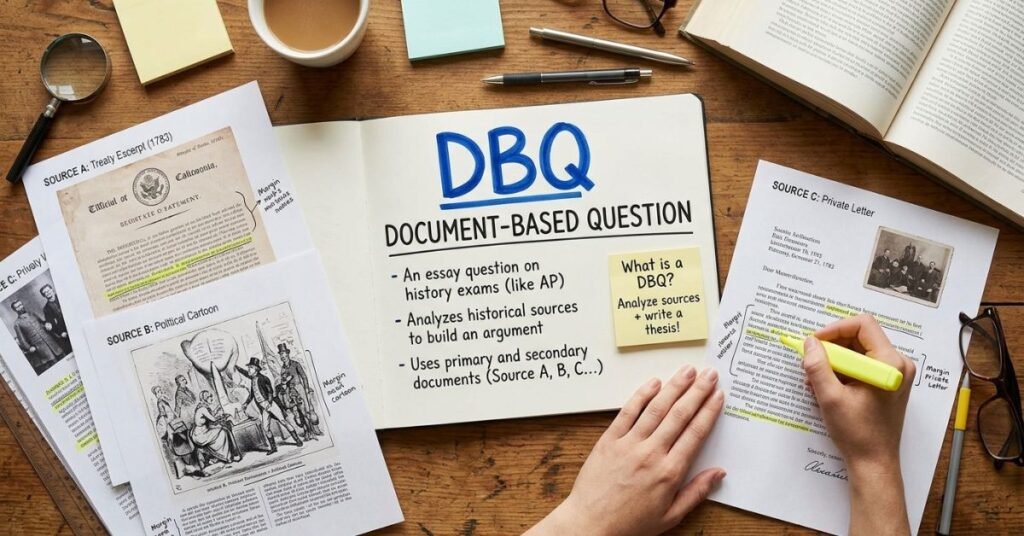
A Document-Based Question is a structured academic task that asks students to answer a question using information from a collection of documents. These documents provide evidence that students must interpret rather than simply copy or summarize.
Depending on the assignment, a DBQ may include primary sources, secondary sources, or a combination of both.
Primary sources are materials created during the historical period being studied or by people directly connected to the event. Examples include personal letters, diaries, speeches, photographs, official records, and newspaper reports published at the time.
Secondary sources are materials that interpret, explain, or analyze historical events after they occurred. Examples include history textbooks, scholarly articles, and historical analyses.
Both types of sources can help students understand an event, but they serve different purposes. A primary source provides direct evidence of a particular person’s experience or perspective, while a secondary source may help explain the broader historical significance of that evidence.
The goal of a DBQ is to combine relevant source material with historical knowledge and reasoning to answer the prompt convincingly.
How Is a DBQ Used in Education?
DBQs are used in classrooms, homework assignments, practice examinations, and formal assessments. Teachers use them to evaluate how effectively students can analyze evidence, organize information, and communicate a reasoned conclusion.
A typical DBQ begins with a prompt followed by several supporting documents. Students read the question, examine the sources, identify relevant evidence, and develop an argument that addresses the central issue.
Consider a question about the effects of the Industrial Revolution. The documents might include factory inspection reports, workers’ letters, economic statistics, and accounts describing changes in urban life.
One document might emphasize increased production and economic growth, while another describes dangerous working conditions and overcrowded housing. Students must compare these perspectives and determine what they reveal about the effects of industrialization.
This process encourages critical thinking because historical sources may present conflicting viewpoints. Students learn to evaluate the reliability, purpose, and significance of evidence rather than assuming that every document tells the complete story.
DBQs can also help students improve their writing skills. A successful response requires a clear thesis, logical organization, relevant examples, and explanations connecting the evidence to the main argument.
What Are the Main Parts of a DBQ?
Most educational DBQs contain three essential elements: a prompt, a collection of documents, and a written response. The exact format depends on the teacher, course, or examination.
1. The DBQ Prompt
The prompt is the central question that students must answer. It establishes the topic and identifies the task, such as explaining causes, comparing perspectives, or evaluating historical change.
For example, a prompt might ask, “To what extent did the Civil Rights Movement transform American society?”
The phrase “to what extent” signals that students should evaluate the degree of change rather than simply describe the movement. Understanding the wording helps students develop an appropriate thesis.
2. The Supporting Documents
The documents provide evidence for investigating the prompt. They may include written sources, maps, political cartoons, photographs, charts, speeches, or official records.
Students should examine not only what each document says but also who created it, when it was produced, why it was created, and whom it was intended to reach.
These details can influence how the evidence should be interpreted. A government announcement, for example, may present a policy differently from a personal letter written by someone affected by that policy.
3. The Written Response
In many history assignments, the final response takes the form of an essay. The essay usually includes an introduction with a thesis, body paragraphs containing evidence and analysis, and a conclusion when required.
The thesis answers the prompt and establishes the argument. The body paragraphs develop that argument using relevant documents and historical knowledge.
A strong response explains why the evidence matters instead of merely repeating information from the sources.
Also Read! What Does EDC Mean? A Complete Guide
How to Write a DBQ Step by Step
Writing a DBQ may seem challenging at first, especially when several documents contain different viewpoints. A structured approach makes the process easier and helps students stay focused on the question.
Step 1: Read the Prompt Carefully
Start by identifying the subject, historical period, and main task. Pay attention to words such as analyze, compare, evaluate, and explain, because they indicate what your response should accomplish.
If the prompt asks you to evaluate the causes of a war, for example, your essay should explain the important causes and assess their significance. Simply describing the war would not fully answer the question.
Step 2: Analyze the Documents
Read each document carefully and identify its central message. Consider the author’s perspective, intended audience, purpose, and historical circumstances.
Suppose a political leader supports a new tax policy in a speech. The speech may explain the government’s reasons for introducing the tax, but the speaker’s position could influence which arguments are emphasized.
Understanding these factors helps students interpret a source instead of accepting every statement without question.
Step 3: Identify Connections Between Sources
Look for documents that support similar ideas, present opposing viewpoints, or reveal different aspects of the same event.
For example, several sources about the Industrial Revolution might discuss economic growth, while others focus on workers’ rights and public health. Grouping these documents into meaningful categories can help organize the essay.
Step 4: Develop a Clear Thesis
A thesis is the main argument of your DBQ. It should directly answer the prompt and establish the reasoning that will guide the essay.
For a question about the American Revolution, a thesis might argue that British taxation, restrictions on colonial self-government, and growing resistance to imperial authority collectively contributed to the conflict.
This statement gives the essay a clear direction. Each body paragraph can then develop one part of the argument with appropriate evidence.
Step 5: Use Documentary Evidence
Support your main points with specific information from the documents. You may quote a short passage, paraphrase a statement, or refer to a particular detail.
However, evidence alone is not enough. Explain how the information supports your claim and why it matters to the overall argument.
For instance, a document describing colonial protests against taxation may demonstrate growing dissatisfaction with British policies. Connecting that evidence to the broader development of colonial resistance makes the analysis stronger.
Step 6: Add Relevant Historical Context
Historical context explains the broader circumstances surrounding the issue. It helps readers understand why an event occurred and why the documents are significant.
When discussing the American Revolution, for example, students might explain the relationship between the French and Indian War, British efforts to raise revenue, and growing disputes over colonial authority.
Outside knowledge should be accurate and relevant to the prompt rather than included simply to make the essay longer.
Step 7: Organize and Review Your Essay
Arrange the argument into a logical sequence. Introduce the topic and thesis, develop each major point in the body paragraphs, and conclude with a clear explanation of the overall argument if the assignment requires it.
Before submitting the essay, check that every paragraph contributes to answering the prompt, documentary evidence is used accurately, and the explanations connect the evidence to the thesis.
Also Read! What Does Seaver Mean? Name Origin, Meaning, and More
What Makes a Good DBQ Essay?
A good DBQ essay presents a clear argument and supports it with relevant evidence. It does not simply summarize the documents or list historical facts.
The thesis is particularly important because it establishes the essay’s direction. A general statement such as “The Industrial Revolution changed society” is less effective than an argument identifying the main economic and social changes and explaining their significance.
Documentary evidence should be specific and accurately interpreted. Students need to explain what a source reveals and how it supports the point being discussed. When appropriate, they should also consider the author’s purpose, perspective, intended audience, and historical situation.
Historical context adds depth to the argument by connecting individual documents to wider developments. Relevant outside knowledge can strengthen this analysis when it is used accurately.
Organization and clarity matter as well. Each paragraph should focus on a main idea, transitions should connect related points, and the conclusion should reflect the argument developed throughout the essay.
The precise scoring requirements vary by assignment and examination, so students should review the relevant rubric rather than assume every DBQ is graded in exactly the same way.
DBQ in AP History: What Students Should Know
In Advanced Placement history courses, DBQ refers to the Document-Based Question included in certain AP history examinations. It evaluates students’ ability to use historical evidence and reasoning to develop an argument.
DBQs are associated with AP United States History, AP European History, and AP World History: Modern.
Students typically receive a historical prompt and a selection of documents. They must interpret the sources, develop a defensible thesis, and use evidence to support their response. Depending on the examination’s current requirements, they may also need to demonstrate historical context, analyze source perspectives, and apply historical reasoning.
The DBQ differs from a conventional recall-based question because the focus is on constructing an argument from evidence. Students need to understand the historical topic, but they must also explain how the sources support their interpretation.
For examination preparation, practicing with official sample questions, scoring guidelines, and sample responses can help students understand what a successful essay looks like. Timing, document requirements, and scoring criteria can change, so current College Board materials are the best reference for the latest AP examination expectations.
DBQ vs. Other History Question Types
DBQs are one of several question formats used in history education. Understanding the differences can help students prepare for assignments and examinations more effectively.
| Question Type | Full Form | Main Purpose | Typical Response |
|---|---|---|---|
| DBQ | Document-Based Question | Analyze provided documents and construct an evidence-based argument | Often an essay |
| SAQ | Short-Answer Question | Respond to focused questions using relevant knowledge or evidence | Brief written answers |
| LEQ | Long Essay Question | Develop a historical argument using historical knowledge and reasoning | Structured essay |
| MCQ | Multiple-Choice Question | Select the best answer from the available options | Selected answer |
A DBQ emphasizes analysis of provided sources. An SAQ usually requires a shorter response, while an LEQ generally relies on students’ historical knowledge and reasoning without the same collection of documents supplied for a DBQ. An MCQ tests knowledge and reasoning through answer choices.
These formats assess overlapping skills, but they require different approaches. Students should always read the instructions and scoring criteria for the specific assignment.
Several abbreviations are associated with history education, document analysis, and disability evaluations. The following table explains common terms and distinguishes established abbreviations from terminology that may vary by context.
| Abbreviation | Full Form | Meaning and Usage |
|---|---|---|
| DBQ | Document-Based Question | An academic question requiring students to analyze documents and support an argument with evidence. |
| AP | Advanced Placement | A program offering college-level courses and examinations to high school students in the United States. |
| SAQ | Short-Answer Question | A question requiring a brief, focused response. |
| LEQ | Long Essay Question | An essay question requiring students to develop a historical argument. |
| MCQ | Multiple-Choice Question | A question with several answer options. |
| HIPP | Historical Context, Intended Audience, Purpose, Point of View | A framework sometimes used to analyze historical sources. |
| HIPPO | Historical Context, Intended Audience, Purpose, Point of View, Outside Evidence | An expanded source-analysis framework used by some teachers. |
| VA | Department of Veterans Affairs | In the United States, the federal department responsible for eligible veterans’ benefits and services. |
| C&P | Compensation and Pension | Refers to the VA’s compensation and pension programs and, in relevant contexts, related examinations. |
| ICD | International Classification of Diseases | A system for classifying and coding diseases and other health conditions. |
HIPP and HIPPO are teaching frameworks rather than universal examination abbreviations, and their exact wording may vary. Similarly, medical abbreviations such as ICD and C&P belong to different contexts from educational DBQs.
Understanding these terms can help students navigate history assignments while helping other readers distinguish educational uses of DBQ from medical or administrative ones.
What Does DBQ Mean in Medical and Disability Benefits Contexts?
Outside education, DBQ can stand for Disability Benefits Questionnaire. This meaning is particularly relevant to certain disability evaluations conducted through the U.S. Department of Veterans Affairs (VA).
A Disability Benefits Questionnaire is a standardized form used to collect medical information relevant to evaluating a particular condition in a disability claim. Depending on the form, it may request details about medical history, symptoms, examination findings, and functional limitations.
These questionnaires help organize information about a person’s condition. Their purpose is different from that of a Document-Based Question, which asks students to interpret documents and construct an academic argument.
A Disability Benefits Questionnaire does not, by itself, guarantee approval of a disability claim. The VA considers the applicable requirements and evidence when making a determination.
Because the abbreviation has two distinct established meanings, the context is essential. A reference to historical sources, an essay, or an AP examination points toward Document-Based Question. A reference to a VA medical form or disability claim points toward Disability Benefits Questionnaire.
Common Mistakes Students Make When Writing a DBQ
One common mistake is summarizing every document separately without developing a central argument. Although summaries can demonstrate understanding, a DBQ requires students to explain how the evidence answers the prompt.
Another mistake is writing a thesis that merely repeats the question. An effective thesis should present a meaningful interpretation and identify the main reasoning behind it.
Students sometimes use quotations without explaining their significance. A quotation becomes useful evidence only when the writer connects it to a claim and explains how it supports the overall argument.
Ignoring the historical circumstances surrounding a document can also weaken the analysis. Understanding who created a source, why it was produced, and what was happening at the time can help explain its meaning and limitations.
Finally, adding unrelated historical facts can distract from the argument. Outside information should help answer the prompt, provide context, or strengthen the interpretation of the documents.
Conclusion
DBQ most commonly stands for Document-Based Question, an academic format that requires students to analyze historical sources and use evidence to support an argument. It is widely associated with history and social studies classes, including AP history examinations.
Writing a successful DBQ involves understanding the prompt, evaluating documents, developing a clear thesis, incorporating historical context, and explaining how the evidence supports the argument. These skills help students move beyond memorization and develop stronger analytical and writing abilities.
In U.S. veterans’ healthcare and disability evaluations, DBQ can instead mean Disability Benefits Questionnaire, a standardized form used to gather medical information relevant to certain disability claims.
Ultimately, the correct meaning depends on the context in which the abbreviation appears. Recognizing that distinction makes it easier to understand DBQ in educational, medical, and administrative settings.
Frequently Asked Questions
What does DBQ stand for in school?
DBQ stands for Document-Based Question in most educational settings. It is an assignment or examination question that asks students to analyze documents and use evidence to develop a response, particularly in history and social studies.
What does DBQ mean in AP World History?
In AP World History: Modern, DBQ stands for Document-Based Question. Students analyze historical sources and use them, along with relevant historical knowledge, to develop an argument that answers a specific prompt.
Is a DBQ the same as an essay?
Not exactly. A DBQ is a question or assignment format, while an essay is a common way of answering it. A DBQ essay uses provided documents as evidence, whereas a general essay may rely on research, personal analysis, or background knowledge without a prescribed set of sources.
How long should a DBQ essay be?
There is no universal word count for a DBQ essay. The expected length depends on the assignment, teacher, or examination. Students should prioritize a complete argument, relevant evidence, and clear analysis while following the applicable instructions.
What is the main purpose of a DBQ?
The main purpose of a Document-Based Question is to assess a student’s ability to analyze sources, interpret evidence, develop an argument, and communicate historical reasoning clearly.
What is the difference between a DBQ and an LEQ?
A DBQ requires students to analyze a set of provided documents, while an LEQ, or Long Essay Question, generally asks students to develop an argument using historical knowledge and reasoning without the same prescribed document set.
Can a DBQ include photographs and maps?
Yes. A DBQ may include photographs, maps, charts, political cartoons, speeches, letters, and official records. Students must interpret each source according to the information it provides and its relevance to the question.
What does DBQ mean in medical terms?
In certain U.S. veterans’ healthcare and disability contexts, DBQ stands for Disability Benefits Questionnaire. It is a standardized form used to collect medical information relevant to certain disability evaluations.
Does completing a DBQ guarantee disability benefits?
No. Completing a Disability Benefits Questionnaire does not guarantee approval. A disability claim is evaluated under the applicable requirements and based on the evidence considered by the relevant authority.
How can I improve my DBQ writing skills?
Practice identifying the prompt’s main task, analyzing documents, grouping related evidence, writing a defensible thesis, and explaining how each source supports your argument. Reviewing scoring rubrics and sample responses can also help you understand the expectations of a particular course or examination.








2 Responses
[…] Also Read! DBQ Meaning: What Does DBQ Stand For and How Is It Used? […]
[…] Also Read! DBQ Meaning: What Does DBQ Stand For and How Is It Used? […]